How Much Do You Need
to Retire?
Model your retirement fund, apply the 4% rule to find your target, and see exactly whether your current savings rate gets you there.
🔒 Every calculation runs in your browser — nothing sent to any server ✓ Calculator reviewed May 2026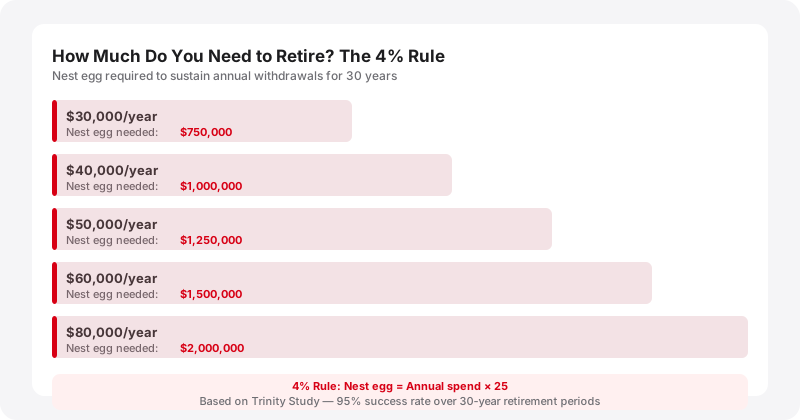
The most common question in personal finance — how much do I need to retire? — has a clean starting answer: 25 times your desired annual income. This comes from the 4% rule, derived from the Trinity Study, which analysed US stock and bond market data from 1925 to 1995. A portfolio withdrawing 4% of its initial value in year one, then adjusting upward for inflation annually, had a 95% or better success rate over 30-year retirement periods across the scenarios tested. Multiply your annual income need by 25, and you have the target fund the 4% rule implies.
You want to spend £30,000 per year in retirement (£4,000/month).
- Target nest egg: $48,000 × 25 = $1,200,000
- Saving £800/month at 7% return: reached in ~32 years
- Starting at 30 → retire at 62
The 4% rule assumes a balanced 50/50 stock-bond portfolio. More equity (e.g. 80/20) historically supports a higher safe withdrawal rate.
This is a starting point, not a final answer. The assumptions behind it are worth understanding before you anchor years of savings planning to it.
What the 4% rule assumes — and where it may not hold
The Trinity Study used US historical market returns, which have outperformed global averages over most of the 20th century. Applying the same methodology to other countries produces lower safe withdrawal rates — sometimes 3–3.5%. It also assumes a 30-year retirement, which may not be long enough for someone retiring at 55 who lives to 95. Many updated analyses, accounting for lower expected bond yields and higher starting equity valuations in today's markets, suggest 3.5% as a more prudent withdrawal rate for new retirees. At 3.5%, a £30,000/year income requires £857,000 rather than £750,000 — a £107,000 higher target for the same lifestyle.
Sequence of returns risk
Two retirees can have identical average returns over 30 years and completely different outcomes depending on when the bad years fall. A 35% market drop in year two of retirement forces sales at depressed prices to fund living costs. Those sold assets never participate in the recovery. The same drop in year 18 — after a decade of compound growth — is far less damaging because the base is much larger. This sequence of returns risk is the primary reason planners recommend holding 1–2 years of living expenses in cash or short-term bonds at retirement, providing a buffer that avoids forced equity sales during downturns.
State pension and Social Security: reduce your private target
The UK full new State Pension is £221.20/week in 2024/25 — around £11,500/year. If your target income is £28,000/year, your private savings only need to generate £16,500/year, requiring roughly £413,000 at the 4% rule rather than £700,000. Check your forecast at gov.uk/check-state-pension. In the USA, your projected Social Security benefit is available at ssa.gov. Including these entitlements in the calculation changes the private savings target by hundreds of thousands in many cases.
How to calculate your retirement pot target
Enter your current age, retirement age, existing savings, and monthly contribution. The calculator projects your fund at retirement using compound growth, then compares it against the fund implied by the 4% rule for your target monthly income. The gap shows whether your current trajectory gets you there — and adjusting the monthly contribution reveals the exact figure that closes it.
State pension and Social Security: include them in the calculation
The UK full new State Pension is £221.20/week (2024/25) — approximately £11,500/year. If your target retirement income is £28,000/year, your private savings only need to generate £16,500/year, requiring a fund of roughly £413,000 at the 4% rule rather than £700,000. Check your State Pension forecast at gov.uk. In the USA, your Social Security statement — available at ssa.gov — shows your projected benefit based on your earnings history and chosen claiming age (62–70). Higher claiming age means a larger monthly benefit. Both of these materially affect your actual savings target.
How to calculate your retirement pot target
Enter your current age and target retirement age, your existing savings, and how much you contribute monthly. The calculator projects your fund at retirement using compound growth at your chosen real return rate, then compares it against the fund you need based on the 4% rule applied to your desired monthly income. The gap — surplus or shortfall — tells you whether your current trajectory gets you there. Adjust the monthly contribution to find the number that closes the gap, then use our savings planner to build that contribution into a concrete monthly plan.
This retirement calculator applies the 4% withdrawal rule to project your fund target based on your desired monthly income, then compares it against what your current savings and contributions will actually produce. Enter your current age, retirement age, existing pension or investment balance, and monthly contributions to see the gap — and the monthly saving needed to close it.
Common questions answered: how much do I need to retire at 60 with £25,000/year income? (approximately £625,000 private savings if State Pension covers the rest), how much pension should I have at 50? (rough target: 10× salary by State Pension age for the 70% income replacement rule), can I retire with £500,000? (yes, at 4% withdrawal: £20,000/year from investments, plus State Pension on top).
UK savers should also consider the pension vs ISA choice — see our guide on pension vs ISA to understand which wrapper to prioritise.
How much do I need to retire on £25,000 a year in the UK?
To retire on £25,000 a year in the UK, apply the 4% rule: divide £25,000 by 0.04 to get a target fund of £625,000. However, if you qualify for the full new State Pension (£11,502 per year in 2025/26), your private savings only need to generate £13,498 per year — requiring a fund of approximately £337,000. Check your State Pension forecast at gov.uk/check-state-pension.
How much should I have saved for retirement at 50?
A widely used rule of thumb: aim to have saved around 10 times your annual salary by retirement age (typically 65–67). At 50, a reasonable target is 5–6 times your annual salary. If you earn £40,000, that suggests a pension pot of £200,000–£240,000 by age 50. This is a rough benchmark — use the retirement calculator above for a projection based on your actual contributions and timeline.
Can I retire at 60 with £500,000?
Yes, potentially — depending on your income requirements. A £500,000 pension pot at the 4% rule provides £20,000 per year from investments. Combined with a partial State Pension (if eligible) and any other income, this may be sufficient. However, retiring at 60 means a 30–35 year retirement, for which 3.5% may be a safer withdrawal rate — requiring £571,000 for the same £20,000/year income.
Frequently Asked Questions
A common rule of thumb is to multiply your desired annual retirement income by 25 (based on the 4% withdrawal rule). If you want $40,000/year in retirement, you need approximately $1,000,000 saved. This assumes a 30-year retirement and a diversified investment portfolio.
The 4% rule states that retirees can withdraw 4% of their portfolio in year one, then adjust for inflation annually, and have a high probability of not outliving their savings over a 30-year retirement. It is based on the Trinity Study using historical US stock and bond returns.
The earlier the better, due to compound growth. However, the most important time to start is always now. Even if you are in your 40s or 50s, increasing your savings rate materially can make a substantial difference. Maximise any employer pension match first.
A realistic long-term real return (adjusted for inflation) for a diversified portfolio of stocks and bonds is approximately 5–7% annually. Using a more conservative 5–6% for planning purposes reduces the risk of overestimating your final fund.