Calorie Calculator:
How Many Do You Actually Need?
Your TDEE — Total Daily Energy Expenditure — calculated using the Mifflin-St Jeor equation, the clinical standard used by registered dietitians worldwide.
🔒 Every calculation runs in your browser — nothing sent to any serverCalculated using official rates — see our methodology. TDEE formula based on Mifflin-St Jeor (1990) peer-reviewed study.
→ Also check your BMI and body fat percentage alongside your calorie target for a complete health picture.
✓ Calculator reviewed May 2026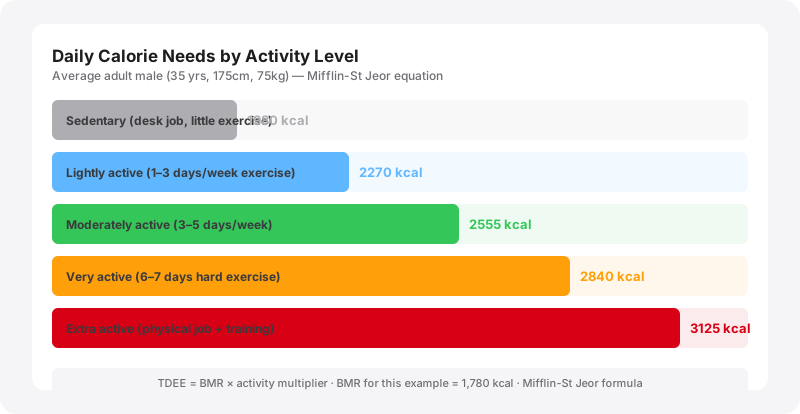
Most people trying to manage their weight focus on food choices — what to eat and what to avoid. The more fundamental question is how much: specifically, how many calories your body burns in a day and whether you are eating above, at, or below that number. That daily total is your TDEE — Total Daily Energy Expenditure — and it is the number this calculator estimates.
How to calculate your daily calorie needs
- Enter your age, sex, height, and weight. These are used by the Mifflin-St Jeor equation to calculate your Basal Metabolic Rate (BMR) — the calories your body burns at rest.
- Select your activity level. Be honest — most people overestimate their activity level. "Sedentary" means a desk job with little exercise; "lightly active" means 1–3 workouts per week.
- Read your TDEE. Your Total Daily Energy Expenditure is the calories you need to maintain your current weight. Eat less to lose weight, more to gain.
- Set a goal. A deficit of 300–500 kcal/day produces sustainable weight loss of 0.3–0.5 kg/week. Avoid deficits larger than 500 kcal without medical guidance.
TDEE has two main components. Your Basal Metabolic Rate (BMR) is the calories your body burns just to stay alive: breathing, circulation, organ function, cell maintenance. For most adults this is 60–70% of total daily calorie burn. On top of that, the Thermic Effect of Activity (TEA) adds calories burned through movement — both structured exercise and everyday activity like walking, fidgeting, and standing.
Why this calculator uses the Mifflin-St Jeor equation
Several formulas exist for estimating BMR. The Harris-Benedict equation (developed in 1919) was the standard for decades. The Mifflin-St Jeor equation, published in 1990, was developed from a larger and more diverse population and has been validated in multiple subsequent studies. A meta-analysis in the Journal of the American Dietetic Association found it accurately predicted resting metabolic rate for most people to within 10%, outperforming Harris-Benedict. Registered dietitians and sports scientists typically use Mifflin-St Jeor for this reason.
Female, 32 years, 165 cm, 65 kg, moderately active
BMR = (10 × 65) + (6.25 × 165) − (5 × 32) − 161 = 1,414 kcal
- Moderately active (×1.55): TDEE = 2,192 kcal/day
- To lose 0.5 kg/week: eat ~1,692 kcal/day (500 kcal deficit)
- To gain 0.5 kg/week: eat ~2,692 kcal/day (500 kcal surplus)
These are estimates — individual metabolism varies by 10–15%. Track your weight for 2 weeks and adjust accordingly.
Ten percent is a meaningful margin of error — it means a 2,200 kcal estimate could be off by up to 220 kcal. This is why the standard advice is to use the calculator as a starting point, track your actual weight for 2–3 weeks while eating at the calculated level, and adjust based on what the scale does rather than what the formula predicts.
Choosing the right activity multiplier
The activity level you select multiplies your BMR to produce your TDEE, and this multiplier has more impact on the final number than most people realise. Moving from "lightly active" to "moderately active" adds roughly 275 calories to a typical adult's daily target — the equivalent of a chocolate bar or a glass of wine. Over a week that is almost 2,000 extra calories.
Most people overestimate their activity level. A desk job with three gym sessions per week is lightly active, not moderately active. Moderately active applies to someone doing genuine physical work or training hard for a sport five days a week. If in doubt, start with the lower option — it is much easier to discover you are losing weight faster than expected and eat a little more, than to wonder why the "moderately active" setting is not producing results.
The three calorie targets
Your TDEE is your maintenance level — eat this to stay roughly the same weight. For fat loss, a deficit of 500 kcal per day below TDEE targets approximately 0.45kg (1lb) of weight loss per week. For muscle gain, a surplus of 250–500 kcal per day combined with resistance training provides energy for growth without excessive fat accumulation. Going above 500 over maintenance tends to add fat rather than muscle at an increasing rate.
What TDEE does not include
TDEE estimates do not account for diet-induced thermogenesis (the calories burned digesting food — roughly 10% of total calories), hormonal conditions that affect metabolism, certain medications, or the metabolic adaptation that occurs after extended periods of calorie restriction. For most healthy adults eating at or near their TDEE, these factors are relatively minor. For anyone with thyroid conditions, a history of prolonged dieting, or other metabolic concerns, working with a registered dietitian rather than a calculator alone is the right approach.
The Mifflin-St Jeor equation is the most widely validated formula for estimating Resting Metabolic Rate (RMR). For men: RMR = (10 × weight in kg) + (6.25 × height in cm) - (5 × age) + 5. For women: the same formula minus 161 instead of plus 5.
A calorie deficit of 500 kcal per day below your TDEE creates approximately 0.45kg (1lb) of weight loss per week. This is considered a safe and sustainable rate for most healthy adults.
TDEE calculators using the Mifflin-St Jeor equation are accurate to within 10% for most people. Actual calorie needs vary with body composition, hormones, and other individual factors. Track your weight over 2-3 weeks and adjust accordingly.
How many calories should I eat to lose weight?
To lose weight, eat 500 calories below your TDEE (Total Daily Energy Expenditure) each day. This creates a 3,500-calorie weekly deficit — approximately 0.45 kg or 1 lb of fat loss per week. A 1,000-calorie daily deficit targets 0.9 kg per week, which is the upper safe limit for most adults. Eating below 1,200 calories/day (women) or 1,500/day (men) risks nutrient deficiency and muscle loss.
What is my TDEE and how is it calculated?
TDEE stands for Total Daily Energy Expenditure — the total calories your body burns per day including exercise and daily activity. It is calculated by multiplying your Basal Metabolic Rate (BMR) by an activity multiplier: 1.2 for sedentary, 1.375 for lightly active, 1.55 for moderately active, 1.725 for very active. This calculator uses the Mifflin-St Jeor equation, the most validated formula for estimating BMR in most adults.
How many calories do I burn at rest per day?
Your calorie burn at complete rest is your Basal Metabolic Rate (BMR). A rough guide: for a 35-year-old woman at 65 kg and 165 cm, BMR ≈ 1,440 calories/day. For a 35-year-old man at 80 kg and 178 cm, BMR ≈ 1,875 calories/day. These are rest-only figures. Add 30–55% for daily activity to reach your full TDEE — the number that actually governs weight change over time.
The Mifflin-St Jeor equation is accurate within ±10% for most people. However, metabolic rate is affected by muscle mass, genetics, hormonal conditions, and medication. Track your weight for 2–3 weeks at your calculated TDEE and adjust by ±100–200 kcal based on results.
Cutting calories aggressively (below 1,200 kcal for women, 1,500 kcal for men) causes muscle loss, nutrient deficiencies, and often rebound weight gain. A moderate deficit of 300–500 kcal/day produces sustainable fat loss of 0.3–0.5 kg per week while preserving muscle.
For weight management, a calorie is a calorie — a 200 kcal deficit produces similar fat loss regardless of whether it comes from carbohydrates, fat, or protein. However, protein has a higher thermic effect and preserves muscle during a deficit, making it worth prioritising.