Salary Calculator:
What Is Your Real Take-Home Pay?
Calculate your net salary after income tax, National Insurance, and pension contributions — for the UK (2024/25) or the USA (2024 federal).
🔒 Every calculation runs in your browser — nothing sent to any serverCalculated using official rates — see our methodology. Tax rates sourced from HMRC published thresholds for 2025/26.
→ Looking for a quick lookup? Jump to the UK take-home pay table below for every salary from £16,000 to £150,000.
✓ Calculator reviewed May 2026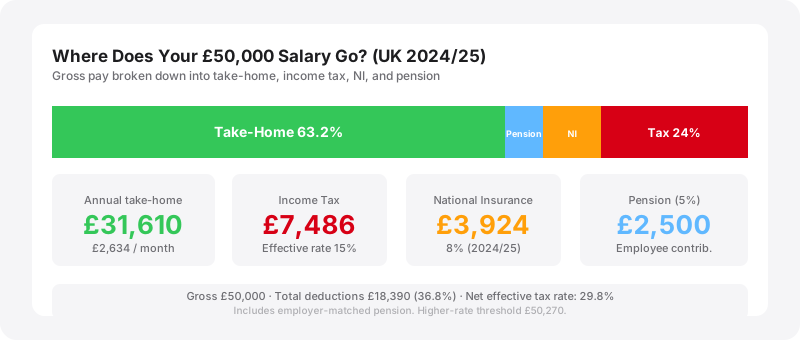
Your gross salary is the number on your offer letter. Your take-home pay is the number that arrives in your bank account. Between them sits a collection of deductions — income tax, National Insurance or Social Security, pension contributions — that most people accept without fully understanding how they are calculated. Knowing the mechanics matters for budgeting, for evaluating job offers, and for understanding what a pay rise is actually worth after deductions.
How to work out your take-home pay
- Enter your gross salary. This is your pre-tax annual salary — the number on your contract or payslip before any deductions.
- Choose UK or US calculation. UK uses income tax bands plus National Insurance. US uses federal income tax plus FICA (Social Security and Medicare).
- Add pension contributions (UK). Enter your pension contribution percentage if applicable. Pension contributions reduce your taxable income, so they affect how much tax you pay.
- Read your take-home pay. The result shows annual and monthly net pay after all deductions. The effective rate shown is your combined tax and NI as a percentage of gross — notice it's lower than the marginal rate.
- Personal Allowance (tax-free): £12,570
- Taxable income: £45,000 − £12,570 = £32,430
- Income Tax (20% basic rate): £6,486
- National Insurance (8% on £35,430): £2,834
- Monthly take-home: £2,974
Earning £50,270+ pushes income into the 40% higher rate band on the excess.
UK income tax: how the bands work
UK income tax uses a progressive banding system. The personal allowance (£12,570 in 2024/25) is completely tax-free. Income between £12,571 and £50,270 is taxed at 20% — the basic rate. Between £50,271 and £125,140 it is taxed at 40% — the higher rate. Above £125,140 it is taxed at 45%. Critically, these bands apply only to income above each threshold — a salary of £55,000 does not mean all income is taxed at 40%. The 40% rate applies only to the £4,730 above the £50,270 threshold, with the lower bands taxed at their own rates on the income within them.
The personal allowance tapers away for high earners. It reduces by £1 for every £2 earned above £100,000, creating an effective 60% marginal tax rate on income between £100,000 and £125,140 — one of the highest effective rates in the UK tax system, and a key reason many earners in this band maximise pension contributions to bring their adjusted income below £100,000.
National Insurance: the parallel system
National Insurance contributions are separate from income tax but equally important to the take-home calculation. For employees in 2024/25, NI is charged at 8% on earnings between £12,570 and £50,270, then 2% on everything above. Like income tax, NI is collected via PAYE for employed workers — the employer deducts it before paying your net salary. Employers also pay their own NI contribution on top of your salary (currently 13.8%), which is why a £40,000 salary costs the employer more like £45,500 in total employment cost.
Pension contributions and tax efficiency
Employer pension contributions and employee contributions made through salary sacrifice reduce your taxable pay before income tax and NI are calculated. A £200/month pension contribution made via salary sacrifice on a basic-rate taxpayer saves approximately £40 in income tax and £16 in NI — meaning the net cost to take-home is only £144 for £200 going into the pension. This tax efficiency is one of the most compelling arguments for maximising pension contributions, particularly before the higher-rate tax threshold.
USA federal tax: a different system
The US federal tax system uses a similar progressive bracket structure but with different thresholds and rates. The standard deduction ($14,600 for single filers in 2024) is subtracted from gross income before brackets apply. FICA (Federal Insurance Contributions Act) taxes — 6.2% Social Security on wages up to $168,600, plus 1.45% Medicare on all wages — are the equivalent of UK National Insurance. Note that this calculator covers federal taxes only; state income tax varies from 0% (Florida, Texas, Nevada) to over 13% (California), and can add materially to the total deduction.
A note on accuracy
This calculator uses standard 2024/25 rates for the UK and 2024 federal rates for the USA. Your actual deductions depend on your specific tax code, any additional allowances, benefits in kind, student loan repayments, or irregular income. For precise figures, your payslip and the HMRC PAYE calculator (UK) or IRS withholding estimator (USA) are more reliable than any general-purpose tool.
This UK salary calculator uses the 2025/26 tax year rates — the personal allowance of £12,570, basic rate band to £50,270, and National Insurance thresholds current from April 2025. It also covers USA federal tax for 2024 using the latest IRS brackets and standard deduction. Enter your annual gross salary above and the calculator shows your monthly and annual take-home pay after income tax and NI deductions.
Common searches: £30,000 salary after tax UK 2026 (approximately £24,942 net), £40,000 take home pay (approximately £31,082), £50,000 salary after tax (approximately £37,022 — where higher-rate tax begins to bite). For USA: $60,000 salary after federal tax is approximately $48,000–$50,000 depending on filing status and state.
How much is £35,000 after tax in 2025/26?
On a £35,000 salary in 2025/26, you pay £4,486 income tax (basic rate on income above the £12,570 personal allowance) and approximately £1,783 National Insurance. Total deductions are £6,269, leaving a take-home pay of £28,731 per year — or approximately £2,394 per month.
What is the income tax rate on a £50,000 salary?
At £50,000, you fall within the basic rate band — 20% income tax applies to earnings between £12,570 and £50,270. Your income tax bill is approximately £7,540. National Insurance adds around £2,968. Total deductions: roughly £10,508, giving a take-home of around £39,492 per year.
At what salary do you pay 40% tax in the UK?
You start paying 40% income tax on any earnings above £50,270 in 2025/26. This is called the higher rate threshold. Only the income above this threshold is taxed at 40% — your first £12,570 remains tax-free and £12,571–£50,270 continues at 20%.
UK take-home pay table 2025/26
The table below shows the exact annual take-home pay at every common salary level in the UK, based on 2025/26 tax rates. All figures assume a standard personal allowance (£12,570), no pension contributions, and no other deductions. Figures are rounded to the nearest pound.
Highlighted rows: £30,000 (median UK salary), £50,270 (higher rate threshold), £100,000 (personal allowance taper begins).
| Gross salary | Income tax | Nat. Insurance | Annual take-home | Monthly take-home | Effective rate |
|---|---|---|---|---|---|
| £16,000 | £686 | £274 | £15,040 | £1,253 | 6.0% |
| £18,000 | £1,086 | £434 | £16,480 | £1,373 | 8.4% |
| £20,000 | £1,486 | £594 | £17,920 | £1,493 | 10.4% |
| £22,000 | £1,886 | £754 | £19,360 | £1,613 | 12.0% |
| £24,000 | £2,286 | £914 | £20,800 | £1,733 | 13.3% |
| £25,000 | £2,486 | £994 | £21,520 | £1,793 | 13.9% |
| £26,000 | £2,686 | £1,074 | £22,240 | £1,853 | 14.5% |
| £28,000 | £3,086 | £1,234 | £23,680 | £1,973 | 15.4% |
| £30,000 | £3,486 | £1,394 | £25,120 | £2,093 | 16.3% |
| £32,000 | £3,886 | £1,554 | £26,560 | £2,213 | 17.0% |
| £35,000 | £4,486 | £1,794 | £28,720 | £2,393 | 17.9% |
| £38,000 | £5,086 | £2,034 | £30,880 | £2,573 | 18.7% |
| £40,000 | £5,486 | £2,194 | £32,320 | £2,693 | 19.2% |
| £42,000 | £5,886 | £2,354 | £33,760 | £2,813 | 19.6% |
| £45,000 | £6,486 | £2,594 | £35,920 | £2,993 | 20.2% |
| £48,000 | £7,086 | £2,834 | £38,080 | £3,173 | 20.7% |
| £50,000 | £7,486 | £2,994 | £39,520 | £3,293 | 21.0% |
| £55,000 | £9,432 | £3,111 | £42,457 | £3,538 | 22.8% |
| £60,000 | £11,432 | £3,211 | £45,357 | £3,780 | 24.4% |
| £65,000 | £13,432 | £3,311 | £48,257 | £4,021 | 25.8% |
| £70,000 | £15,432 | £3,411 | £51,157 | £4,263 | 26.9% |
| £75,000 | £17,432 | £3,511 | £54,057 | £4,505 | 27.9% |
| £80,000 | £19,432 | £3,611 | £56,957 | £4,746 | 28.8% |
| £90,000 | £23,432 | £3,811 | £62,757 | £5,230 | 30.3% |
| £100,000 | £27,432 | £4,011 | £68,557 | £5,713 | 31.4% |
| £110,000 | £31,432 | £4,211 | £74,357 | £6,196 | 32.4% |
| £125,000 | £37,432 | £4,511 | £83,057 | £6,921 | 33.6% |
| £150,000 | £48,675 | £5,011 | £96,314 | £8,026 | 35.8% |
How to read this table
Income tax is calculated after deducting the personal allowance (£12,570). The first £37,700 of taxable income is taxed at 20% (basic rate); income above £50,270 is taxed at 40% (higher rate); income above £125,140 at 45% (additional rate). The personal allowance is tapered for incomes above £100,000.
National Insurance is charged at 8% on earnings between £12,570 and £50,270, and 2% above that. Employer NI is not included — these figures show employee deductions only.
Effective rate is the combined income tax and NI as a percentage of gross salary. Note this is lower than the marginal rate — a £50,000 earner pays a combined effective rate of around 21.0%, not the headline 40%.
These figures do not include pension contributions, student loan repayments, childcare vouchers, or any other deductions. Use the calculator above to model your specific situation.
Frequently Asked Questions
Gross salary is your pay before any deductions. Net salary (take-home pay) is what you receive after income tax, National Insurance or Social Security, and any pension contributions are deducted.
On a £35,000 salary in 2024/25, you pay approximately £4,486 in income tax (20% on income above the £12,570 personal allowance) and approximately £1,783 in National Insurance. Total deductions of around £6,269, leaving a take-home of approximately £28,731.
The UK personal allowance is £12,570 for the 2024/25 tax year. Income below this threshold is completely tax-free. The allowance is gradually withdrawn for incomes above £100,000.
US federal income tax uses a progressive bracket system. For 2024, a single filer subtracts the $14,600 standard deduction from gross income, then applies rates from 10% to 37% on each portion of taxable income. State income tax is additional and varies by state.