VAT Calculator:
Add or Remove VAT
Calculate the VAT on any price instantly — add VAT to a net figure or strip it from a gross price — for any EU or UK rate.
🔒 Every calculation runs in your browser — nothing sent to any serverCalculated using official rates — see our methodology. VAT rates from HMRC published schedule of goods and services.
✓ Calculator reviewed May 2026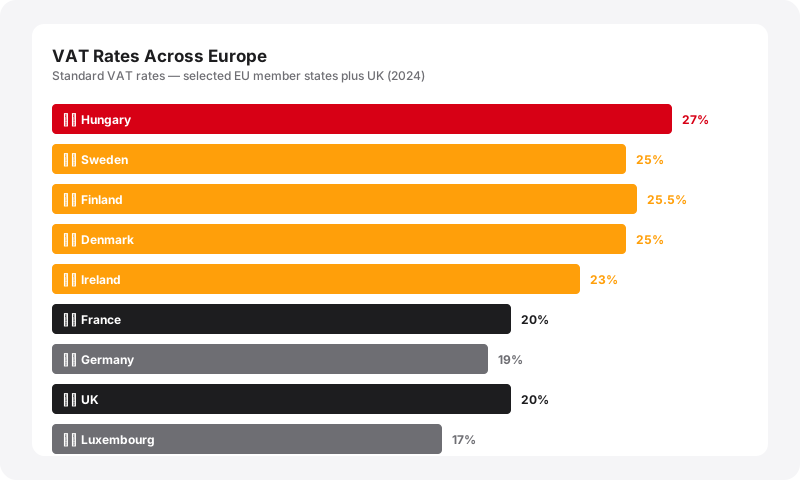
Value Added Tax is the most misunderstood tax in everyday commerce. Most people know VAT exists and roughly what rate it is. Far fewer understand how it flows through the supply chain, why the "remove VAT" calculation is not simply subtracting the percentage, or which goods and services are actually exempt or zero-rated versus merely VAT-free for the end consumer. Getting these details wrong is an expensive mistake for businesses, and a useful gap in knowledge for consumers doing price comparisons.
How to add or remove VAT from any price
- Enter the amount. Type the price you want to add VAT to, or the VAT-inclusive price you want to remove VAT from.
- Choose add or remove VAT. Select "Add VAT" if you have a net price and want the gross (consumer price). Select "Remove VAT" if you have a gross price and want the net (ex-VAT) figure.
- Select your VAT rate. Choose from UK standard (20%), UK reduced (5%), or any of the 27 EU member state rates. The rate is pre-filled with UK standard.
- Read your results. You'll see the net amount, VAT amount, and gross amount. The calculation is shown so you can verify it manually.
Adding VAT: A product costs £80 net. At UK standard rate 20%:
£80 × 1.20 = £96 gross (VAT = £16)
Removing VAT: A receipt shows £96 including VAT at 20%:
£96 ÷ 1.20 = £80 net (VAT = £16)
A common mistake: dividing by 0.20 instead of 1.20 to remove VAT gives the wrong answer.
How VAT actually works
VAT is collected at every stage of the supply chain, not just at point of sale to the consumer. A manufacturer buys raw materials with VAT charged by the supplier. They sell their product to a wholesaler and charge VAT. The wholesaler sells to a retailer and charges VAT. The retailer sells to you and charges VAT. At each stage, the business claims back the VAT it paid on inputs (input VAT) and remits the VAT it charged on outputs (output VAT). Only the difference reaches the government. This mechanism means that the full VAT burden ultimately falls on the end consumer who cannot reclaim — which is you when shopping for personal use.
For businesses this creates a paper trail that allows tax authorities to cross-check VAT payments across the supply chain. A supplier claiming to have paid VAT should show up in a buyer's reclaim. This mutual checking mechanism is why VAT fraud is harder to perpetrate undetected than simpler sales taxes.
The critical maths: adding vs removing VAT
Adding VAT to a net price is straightforward: multiply by 1.20 for UK standard rate (1 + 0.20 = 1.20). A £100 net price becomes £120 including VAT. The VAT element is £20.
Removing VAT from a gross price trips people up constantly. The instinct is to subtract 20% from £120 — which gives £96, not £100. This is wrong because the 20% was applied to the net price (£100), not the gross price (£120). To correctly remove VAT: divide the gross price by (1 + VAT rate). £120 ÷ 1.20 = £100. The net price is £100 and the VAT element is £20. This calculator handles both directions correctly.
UK VAT rates: three tiers, not one
The UK has three VAT rates, and confusing them costs businesses money. Standard rate (20%): most goods and services. Reduced rate (5%): domestic fuel and power, children's car seats, mobility aids, certain energy-saving materials, and women's sanitary products. Zero rate (0%): most food (but not restaurant meals, hot takeaways, or confectionery), children's clothing and footwear, books and newspapers, public transport fares, most medicines on prescription, and new residential buildings. Zero-rated goods are technically VATable but at 0% — the distinction matters because it allows businesses to reclaim input VAT on zero-rated supplies, unlike genuinely exempt supplies where input VAT cannot be reclaimed.
EU VAT rates
European VAT rates are set by each member state within EU minimum rules (a standard rate of at least 15%). Standard rates range from Hungary's 27% down to Luxembourg's 17%. Most major economies sit between 19% (Germany) and 25% (Sweden, Denmark). Reduced rates for essentials like food, medicines, and public transport vary widely by country. The UK, post-Brexit, no longer follows EU VAT rules and now sets its own rates and categories independently — the divergence has been modest so far but will likely grow over time.
VAT registration threshold
UK businesses must register for VAT when their taxable turnover exceeds £90,000 in any rolling 12-month period (2024/25 threshold, raised from £85,000 in April 2024). Voluntary registration is possible below the threshold — sometimes advantageous if your customers are mostly VAT-registered businesses who can reclaim the VAT you charge, and if your input VAT on purchases is material. The decision is worth running past an accountant rather than making on instinct.
This VAT calculator handles both directions: adding VAT to a net (ex-VAT) price, and removing VAT from a gross (inc-VAT) price. Select your rate — UK standard 20%, reduced 5%, or any EU rate — enter the amount, and the result shows the VAT element and the gross or net figure instantly.
The most searched VAT queries this calculator answers: how to add 20% VAT to £100 (answer: £120), how to remove VAT from £120 (answer: divide by 1.20 = £100, NOT subtract 20%), VAT on £850 (at 20%: £170 VAT, £1,020 gross), and reverse VAT calculation — finding the net price hidden inside a VAT-inclusive total.
How do I add 20% VAT to a price?
To add 20% VAT to a price, multiply the net amount by 1.20. Adding VAT to £100 gives £120. Adding VAT to £85 gives £102. The formula is: gross price = net price × (1 + VAT rate). For 5% VAT: multiply by 1.05. For 23% (Ireland): multiply by 1.23.
How do I remove VAT from a price?
To remove 20% VAT from a gross price, divide by 1.20 — do not subtract 20% directly. Dividing £120 by 1.20 gives £100 net. Subtracting 20% of £120 (£24) incorrectly gives £96. The correct formula is: net price = gross price ÷ (1 + VAT rate). This is called a reverse VAT calculation.
What is the VAT on £1,000?
VAT on £1,000 at the UK standard rate of 20% is £200. The total price including VAT is £1,200. At the 5% reduced rate, VAT is £50 giving a total of £1,050. If the £1,000 already includes VAT at 20%, the VAT element is £166.67 and the net price is £833.33.
Frequently Asked Questions
Multiply the net price by (1 + VAT rate). For UK VAT at 20%: multiply by 1.20. So a £100 net price becomes £120 including VAT.
Divide the gross price by (1 + VAT rate). For 20% VAT: divide by 1.20. A £120 gross price becomes £100 net. Do not simply subtract 20% — that gives the wrong answer.
The UK standard VAT rate is 20%. A reduced rate of 5% applies to domestic energy and some other goods. Many essentials including most food, children's clothing, and books are zero-rated.
In the UK, businesses must register for VAT when their taxable turnover exceeds £90,000 in any 12-month period (2024/25 threshold). In EU countries, thresholds vary by member state.