What Is a Good Mortgage Rate in 2026?
Mortgage rates shift constantly — but understanding what a "good" rate looks like in 2025 could save you tens of thousands over the life of your loan.
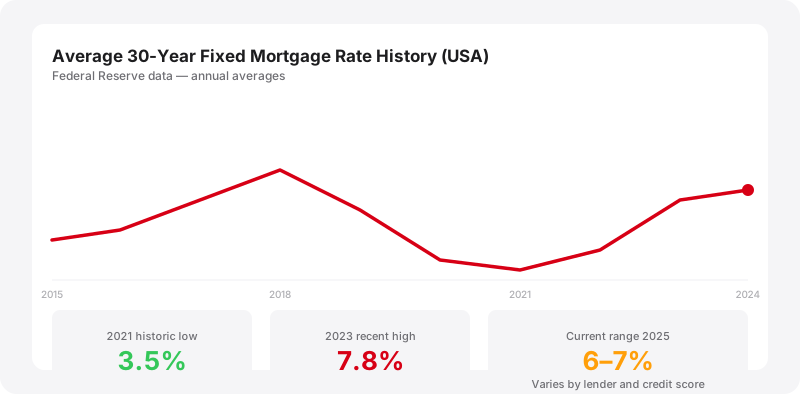
Mortgage rates are one of the most consequential numbers in personal finance. A difference of just 0.5% on a $350,000 loan over 30 years is worth over $30,000 in total interest. Whether you are buying your first home, remortgaging, or comparing international options, understanding what a "good" rate looks like in 2025 matters.
What are mortgage rates in 2026?
Rates have fallen materially from the peaks of 2022–2023 in most major markets, but remain elevated compared to the historically low rates of 2020–2021. Here is where things stand heading into 2025:
- USA (30-year fixed): Average rates have fallen back toward the 6.5–7.0% range, from the 8% peak of late 2023. The Federal Reserve's rate-cutting cycle, which began in late 2024, is gradually filtering through to mortgage lending.
- UK (2-year fixed): Average rates have fallen from a peak above 6.5% to around 4.5–5.0% for borrowers with large deposits. Five-year fixes are typically priced 0.1–0.3% lower than 2-year deals.
- Eurozone: Variable and tracker rates tied to the ECB base rate have eased as the ECB cut rates through 2024. Fixed-rate deals in Germany, France and the Netherlands sit broadly in the 3.5–4.5% range for well-qualified borrowers.
What counts as a good rate?
A "good" mortgage rate is relative — it depends on the current market, your deposit size, your credit profile, and the loan type. The best available rates in any market go to borrowers who tick every lender's box: large deposit (40%+), excellent credit score, low debt-to-income ratio, and stable employment history.
"You are not comparing yourself to a rate from five years ago — you are comparing yourself to what other borrowers with your profile can get today. That is the only benchmark that matters."
As a rough rule of thumb: if your offered rate is within 0.25–0.5% of the best publicly advertised rate for your deposit tier, you are doing well. If it is more than 0.75% above the best available, it is worth shopping around or using a mortgage broker.
What affects your mortgage rate?
- Loan-to-Value (LTV) ratio: The single biggest factor. The less you borrow relative to the property value, the lower your rate. 60% LTV gets materially better rates than 90% LTV.
- Credit score / history: Missed payments, CCJs (UK), or bankruptcies push rates up dramatically, or disqualify you from some lenders entirely.
- Loan type: Fixed-rate loans currently price differently to trackers and discounted variable rates. Fixed rates offer certainty; trackers can outperform or underperform depending on central bank decisions.
- Loan term: Shorter terms (15 years vs 30) typically get lower rates, and dramatically lower total interest, though monthly payments are higher.
- Property type: New builds, high-rise flats, and non-standard construction properties sometimes attract higher rates or restricted lender availability.
How to get the best rate
- Check your credit file before applying — errors are more common than you think, and fixing them takes time.
- Save a larger deposit if you are close to an LTV threshold (e.g., 85% vs 80% makes a meaningful difference).
- Use a whole-of-market broker — especially in the UK, where brokers have access to exclusive deals not available directly. Many charge no upfront fee, taking commission from lenders instead.
- Get an Agreement in Principle before you start viewing properties — it clarifies your budget and shows sellers you are serious.
- Consider the total cost, not just the rate — some attractive headline rates come with large arrangement fees that make them more expensive than a slightly higher rate with no fee.
Use our mortgage calculator to see exactly how different rates affect your monthly payment and total interest paid over the life of your loan.
Common mistakes first-time buyers make with mortgage rates
The most expensive mistake is accepting the first offer. A 2024 survey by the Money Advice Service found that over a third of UK first-time buyers did not compare mortgage deals before accepting their initial offer. On a £250,000 mortgage, the difference between the best and worst rate available to the same borrower can be 1–1.5% — worth £25,000–£40,000 in total interest over 25 years.
The second mistake is optimising for monthly payment rather than total cost. A slightly higher monthly payment on a shorter-term or lower-rate mortgage often costs less in total over the life of the loan. Always calculate the total repayable, not just what goes out each month.
Third: ignoring the reversion rate. Fixed-rate mortgages revert to the lender's Standard Variable Rate (SVR) at the end of the fixed period. SVRs are typically 2–4% above the best available deals. Budget time to remortgage before your fixed term ends — being moved onto the SVR for even 3–6 months can cost hundreds of pounds.
How to improve the rate you are offered
Your credit score is the starting point lenders use to decide which products to offer you and at what pricing tier. In the UK, check your Experian, Equifax, and TransUnion files before applying — errors appear in a material proportion of credit files and can be disputed. Paying down existing credit card balances before your application reduces your utilisation ratio, which helps your score. Avoid applying for other credit in the 3 months before a mortgage application; every hard search leaves a footprint.
A larger deposit does more than reduce the loan amount — it moves you to a lower LTV band where better rates become available. The biggest jumps in pricing typically occur at the 95%, 90%, 85%, 80%, and 75% LTV thresholds. If you can stretch your deposit slightly to cross one of these lines, the rate saving usually outweighs the extra saving required.
Sources & references
Historical context: where mortgage rates have been
To understand whether a rate is good, it helps to know where rates have been. In the UK, the Bank of England base rate sat at historic lows between 2009 and 2021 — falling to just 0.1% at the height of the pandemic. During this period, two-year fixed mortgage rates regularly fell below 1.5%, and five-year fixes were available below 2%. These were historically anomalous — the product of emergency monetary policy rather than the new normal, though they persisted long enough to feel like one.
Since 2022, as central banks responded to inflation, rates rose sharply across all major economies. By late 2023, the average UK two-year fix had climbed above 6%, before easing back as inflation fell. US 30-year fixed rates moved from under 3% in 2021 to above 7% in 2023, their highest since 2001. By 2025, both markets have settled into a range that is higher than the 2010s but more normal by historical standards. Borrowers who took out mortgages in 2019–2021 are experiencing genuine payment shock on remortgage; for first-time buyers in 2025, these rates are simply the starting point.
The practical implication: a rate that feels expensive compared to the 2020–2021 period is not objectively bad. What matters is your rate relative to the current market, not relative to a decade-low anomaly.
Fixed vs variable: which is better right now?
The choice between fixed and variable rates is essentially a bet on the direction of interest rates. Fixed gives certainty: you know your payment for the term regardless of what central banks do. Variable (or tracker) gives flexibility: your rate moves with the base rate, up or down. When rates are high and expected to fall, the case for variable is stronger — you would benefit automatically from cuts without needing to remortgage. When rates are low and expected to rise, fixing protects you.
In 2025, most UK lenders and independent financial advisers lean toward two to five-year fixes for most borrowers, on the basis that while rates may fall somewhat, the deep cuts needed to return to 2020-era levels are unlikely. Trackers make more sense for buyers who expect to sell or remortgage within two years, or those with flexible enough finances to absorb payment increases if rates rise.
The difference between the headline rate and the APRC
When comparing mortgage offers, the headline interest rate is only part of the picture. Every UK mortgage provider is legally required to show the Annual Percentage Rate of Charge (APRC), which incorporates fees, charges and the rate applicable after any initial deal period ends. A mortgage marketed at 4.2% with a £1,499 arrangement fee and reversion to a 7.5% standard variable rate will cost more in total than a 4.5% mortgage with no fees and a lower reversion rate — even though the headline rate looks better.
Always calculate the total cost over your likely holding period, not just the monthly payment on the headline rate. Mortgage brokers do this comparison automatically as part of their service; if you are applying direct, use each lender's mortgage comparison tools or a fee-free broker to see the true comparative costs across the initial period and beyond.
Loan-to-value brackets and their effect on your rate
Your loan-to-value ratio (LTV) is the mortgage amount expressed as a percentage of the property value. A £240,000 mortgage on a £300,000 property is 80% LTV. This matters because lenders price risk. The lower your LTV, the less the lender stands to lose if you default and the property has to be sold in a falling market — so they reward you with a lower rate.
The key thresholds in the UK market are 90%, 85%, 80%, 75%, 70% and 60% LTV. Each step down typically reduces your rate by 0.1–0.4 percentage points. Going from 90% LTV to 75% — which requires a deposit of 25% rather than 10% — can save 0.5–1.0 percentage point on your rate. On a £300,000 mortgage over 25 years, a 0.5% rate reduction saves approximately £70–90 per month and around £25,000 in total interest. If you are close to a LTV threshold, it is often worth finding additional deposit funds — from family, savings, or delaying purchase — to step down into the next bracket.
When to remortgage and what to watch for
Most people remortgage when their initial fixed period ends, because at that point they revert to the lender's standard variable rate (SVR), which is typically 2–3 percentage points above what they could get elsewhere. You should start the remortgage process four to six months before your fixed deal ends. Mortgage offers are typically valid for three to six months, so you can lock in a new rate before your current deal expires without paying early repayment charges.
Watch for early repayment charges (ERCs) on your current mortgage before acting. These are typically 1–5% of the outstanding balance in the first year of a fix, declining over the deal period. In some cases, particularly if rates have fallen significantly, it is worth paying the ERC to escape a high-rate fix early — but calculate the actual saving against the cost before proceeding.
What is a good mortgage rate in 2026?
A good mortgage rate in 2026 is generally 4.0–4.5% for a UK 5-year fixed with a 25% deposit, and 6.5–7.0% for a US 30-year fixed with 20% down. Rates vary significantly based on your deposit size, credit score, and lender.
What factors affect your mortgage rate?
The main factors are your loan-to-value ratio (lower LTV = better rate), credit score, income stability, property type, and whether you choose a fixed or variable rate. Your choice of mortgage term also affects the rate offered.
Should I fix or take a tracker mortgage?
A fixed rate gives payment certainty regardless of Bank Rate changes. A tracker rate moves with the base rate — beneficial when rates fall, risky when they rise. Most first-time buyers choose a 2- or 5-year fixed for predictability.
Using a mortgage broker versus going direct
A fee-free mortgage broker has access to deals from across the market, including products not available directly from lenders. They also understand lender criteria — which lenders are more flexible on contract workers, which favour applicants with complex income, and which have the fastest processing times. For most borrowers, a broker finds a better rate than applying directly, and the service costs nothing if the broker is paid by the lender on completion. Whole-of-market brokers are preferable to tied brokers who only offer products from a panel of lenders. London & Country, Trussle, and Habito are well-regarded fee-free brokers in the UK. In the US, mortgage brokers similarly offer access to multiple lenders, though direct lenders such as Rocket Mortgage have built efficient application processes that suit straightforward cases.