The True Cost of Any Loan
Monthly payment is only half the story. See the total interest you will pay over the full term of any personal loan, car finance, or credit line.
🔒 Every calculation runs in your browser — nothing sent to any serverCalculated using official rates — see our methodology. APR calculation follows FCA Consumer Credit sourcebook standards.
✓ Calculator reviewed May 2026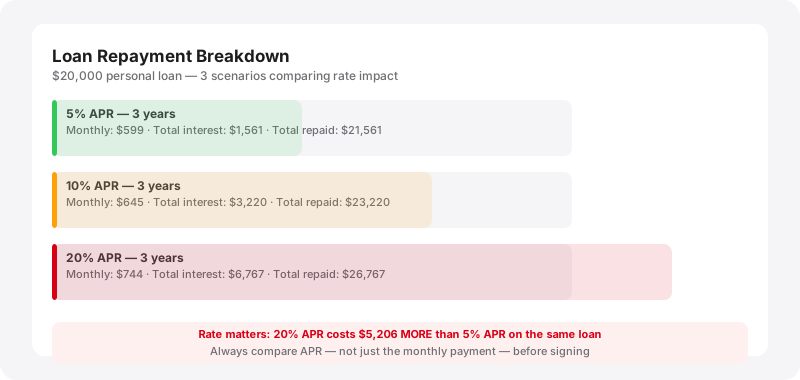
Every loan has two prices. The first is the monthly payment — the number lenders advertise and borrowers remember. The second is the total amount repaid over the life of the loan — the number that tells you what borrowing actually costs. The gap between them is the total interest, and on most consumer loans, that gap is larger than borrowers realise until they look at it directly.
How to calculate your loan repayments
- Enter the loan amount. The total you want to borrow — not including any existing debt.
- Enter the interest rate (APR). Use the APR (Annual Percentage Rate), not just the interest rate. APR includes all fees and is the true cost comparison figure.
- Set the loan term. Longer terms mean lower monthly payments but more total interest. Try different terms to find the right balance.
- Read your results. The calculator shows your monthly payment, total interest, and total repaid. Compare different rates to see the real cost difference.
You borrow £10,000 at 8% APR over 3 years (36 months).
- Monthly payment: £313
- Total paid: £11,281
- Total interest: £1,281 — about 12.8% of the loan
At 15% APR the same loan costs $1,750 more over 3 years — always compare APR, not just monthly payments.
On a £15,000 personal loan at 7.9% over 5 years, the monthly payment is £304. Total repayment: £18,241. You repay £3,241 beyond the original £15,000 — 21% of the original loan amount, paid to the lender. That is the real cost of borrowing.
APR: the number that matters for comparison
Interest rate and APR (Annual Percentage Rate) are not the same thing. The headline interest rate describes the cost of borrowing the principal. APR includes the interest rate plus any fees — arrangement fees, administration charges, insurance premiums sold alongside the loan — and expresses them as a single annualised rate. By law in both the UK and USA, lenders must disclose APR. It is the only fair basis for comparing loans from different providers.
A loan advertised at 6.9% with a £200 arrangement fee can have an APR higher than a loan advertised at 7.4% with no fee, depending on the loan amount and term. Always use APR for comparison, not the headline rate.
Term length: the trade-off nobody explains clearly
Stretching a loan over a longer term reduces the monthly payment but raises the total interest paid. On a £20,000 car loan at 7%:
Over 3 years: £618/month, total interest £2,255. Over 5 years: £396/month, total interest £3,762. Over 7 years: £300/month, total interest £5,196.
The 7-year option costs £2,941 more in interest than the 3-year option. In exchange, the monthly payment is £318 lower. Whether that trade-off is worthwhile depends entirely on your cash flow — but borrowers who choose longer terms primarily to make the payment feel affordable often have not done this calculation.
Early repayment: usually worth it
Most personal loans allow early repayment, sometimes with a charge. In the UK, the Consumer Credit Act caps early repayment charges at 1–2 months of interest, which is almost always less than the interest you save by clearing the debt. In the USA, most personal loans have no prepayment penalty at all. If you come into extra money, checking your loan agreement before making an early repayment takes 5 minutes and is almost always worthwhile.
Types of loan and when they make sense
Personal unsecured loans — the type this calculator is designed for — are appropriate for medium-sized expenses at defined amounts: car purchase, home improvements, debt consolidation, or a one-off large cost. They are generally cheaper than credit cards for amounts over £2,000–£5,000 held for more than a few months. They are almost always more expensive than mortgages, which is why rolling personal debt into mortgage refinancing is sometimes considered — though it converts unsecured debt to secured debt, putting your home at risk.
Early repayment almost always saves money on interest. Check your loan agreement for early repayment charges first — some lenders cap these at 1-2 months of interest. Any penalty is usually worth paying if you can afford to clear the debt.
→ Buying a home? Use our mortgage calculator for long-term home loan repayments.
Personal loans are commonly used for debt consolidation, home improvements, car purchases, medical expenses, or major life events. They typically have fixed interest rates and set repayment terms of 1-7 years.
What are the monthly repayments on a £10,000 loan?
Monthly repayments on a £10,000 personal loan depend on APR and term. At 6.9% APR over 3 years: £308/month, total repayable £11,082. Over 5 years: £198/month, total £11,857. At 12% APR over 3 years: £332/month, total £11,963. A longer term always lowers monthly payments but increases total interest paid — sometimes by more than the original loan amount for high rates over long terms.
What is the difference between interest rate and APR on a loan?
The interest rate is the annual cost of borrowing the principal only. APR (Annual Percentage Rate) includes the interest rate plus all mandatory fees — arrangement fees, admin charges, compulsory insurance. By law, UK and US lenders must disclose APR, making it the only fair basis for comparing loans from different providers. A loan with a low headline rate but a large arrangement fee can cost more total than a higher rate with no fees.
How much interest do I pay on a personal loan at 7%?
On a £10,000 personal loan at 7% APR over 3 years, total interest is approximately £1,099 — about 11% of the principal. Over 5 years at the same rate, total interest rises to approximately £1,859. At 15% APR over 3 years, interest on £10,000 is roughly £2,480. The calculator above shows the precise figure for any amount, rate and term — run a few scenarios before committing to a lender.
The interest rate is the base cost of borrowing. APR (Annual Percentage Rate) includes the interest rate plus fees, arrangement costs, and other charges, expressed as a yearly percentage. Always compare APR — it shows the true cost of the loan.
Most personal loans allow early repayment, but lenders often charge an early repayment fee equivalent to 1–2 months of interest. Calculate whether the interest saved outweighs the penalty before paying early.
A higher credit score means lower risk for lenders and a lower interest rate for you. The difference between a good and excellent credit score can be 2–5 percentage points on a personal loan — on a £10,000 loan over 3 years that is £300–£900 in extra interest.