How Credit Scores Work — and How to Improve Yours
Your credit score determines your mortgage rate, loan approval, and sometimes even your rental application. Here is exactly what it measures and how to improve it.
Your credit score is one of the most consequential numbers in personal finance — it determines whether you get approved for a mortgage, what interest rate you pay on loans, and sometimes even whether a landlord will rent to you. Yet most people have only a vague idea of what it actually measures or how to improve it.
This article is for informational and educational purposes only. It does not constitute personalised financial advice. Please consult a qualified independent financial adviser before making significant financial decisions.
What is a credit score?
A credit score is a three-digit number — typically between 300 and 850 in the US (FICO scale) or 0–999 in the UK (Experian) — that summarises your history of borrowing and repayment. Lenders use it as a quick signal of how likely you are to repay a new loan.
In the UK, the three main credit reference agencies are Experian, Equifax, and TransUnion. Each uses slightly different scales and data, so your score will differ between agencies. In the US, most lenders use FICO scores, though VantageScore is also widely used.
What makes up your credit score?
FICO breaks down its score into five weighted components:
- Payment history (35%) — the most important factor. A single missed payment can drop your score by 60–110 points. Payments more than 30 days late are reported to credit agencies.
- Credit utilisation (30%) — how much of your available credit you're using. Staying below 30% is widely recommended; below 10% is better for top scores.
- Length of credit history (15%) — older accounts help. Closing a long-standing account can shorten your average account age and hurt your score.
- Credit mix (10%) — having different types of credit (credit cards, loans, mortgage) can help, though this is the least important factor.
- New credit enquiries (10%) — each hard credit search (for a loan, card, or mortgage application) temporarily reduces your score by 5–10 points.
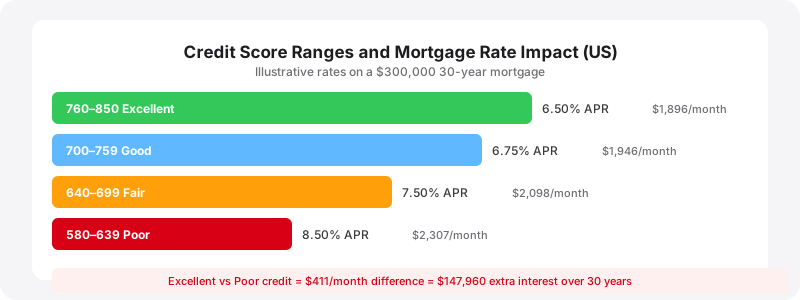
On a $300,000 30-year mortgage (US, illustrative rates):
- Score 760–850 (Excellent): 6.5% → $1,896/month
- Score 700–759 (Good): 6.75% → $1,946/month
- Score 640–699 (Fair): 7.5% → $2,098/month
- Score 580–639 (Poor): 8.5% → $2,307/month
Moving from Fair to Excellent credit saves $202/month and $72,720 over 30 years on the same loan.
How to check your credit score
UK: All three agencies offer free credit reports. Experian and Equifax offer free monthly score checks via their apps. ClearScore (uses Equifax data) and Credit Karma (TransUnion) are also free permanently.
US: You're entitled to one free credit report per year from each of the three major bureaus via AnnualCreditReport.com. Many banks and credit cards now offer free FICO score access as a standard feature.
Checking your own score is a soft enquiry and does not affect your score.
How to improve your credit score
These actions have the most impact, roughly in order of effectiveness:
- Never miss a payment — set up direct debits for at least the minimum on every account. One missed payment can take 12–24 months to stop materially affecting your score.
- Reduce your credit utilisation — if you have a £5,000 credit limit and use £3,500, your utilisation is 70%. Pay it down to below £1,500 and your score will often jump within one billing cycle.
- Register on the electoral roll (UK) — this is one of the fastest score improvements available in the UK. Lenders use it to verify your address and identity.
- Don't close old accounts — a long-standing account with no balance is a free credit score booster. Only close accounts with fees you can't justify.
- Avoid multiple applications in quick succession — if you're shopping for a mortgage, most lenders recommend doing all applications within a 14–45 day window, as credit bureaus treat clustered mortgage enquiries as a single hard pull.
- Fix errors on your report — approximately 1 in 5 credit reports contains a material error. Dispute any inaccuracies directly with the credit bureau.
How long does it take to improve?
Small improvements (reducing utilisation, registering on the electoral roll) can show within 30–60 days. Recovering from a missed payment or default typically takes 2–4 years for the impact to fade significantly, even if the account is brought up to date. A bankruptcy stays on a UK credit file for 6 years; in the US, Chapter 7 bankruptcy stays for 10 years.
The good news: the impact of negative marks fades over time, and consistent positive behaviour — always paying on time, keeping utilisation low — consistently outweighs older negatives.
Common credit score myths debunked
Myth: Checking your own score damages it. False. Checking your own credit report is a "soft enquiry" and has zero impact on your score. Only "hard enquiries" — from lenders when you apply for credit — cause a temporary dip.
Myth: Closing unused credit cards improves your score. Often the opposite. Closing an old card reduces your total available credit (pushing utilisation up) and can shorten your average account age. Keep old accounts open unless they carry an annual fee you can't justify.
Myth: You have one credit score. In the UK you have three (one from each major bureau) and they will differ. In the US, you have dozens of variants of FICO scores, weighted differently for different lending decisions — a mortgage lender uses different weighting than a credit card issuer.
Myth: A higher income means a better credit score. Income is not a factor in your credit score. A high earner who misses payments will have a worse score than a lower earner who pays everything on time. Use our loan calculator to see how your credit score affects the true cost of a loan.
UK vs US credit scoring: key differences
Credit scoring works differently in the UK and US, and understanding the system in your country matters for interpreting your score. In the UK, there is no single universal credit score. Experian, Equifax and TransUnion each maintain their own databases and calculate their own scores using different methodologies. A lender might use any one, two, or all three when assessing your application — and your scores can differ significantly between agencies because not all creditors report to all three.
Experian uses a scale of 0–999, with 721–880 classed as "Good" and 881–960 as "Excellent." Equifax uses 0–1000. TransUnion (formerly Callcredit) uses 0–710. These numbers are not directly comparable. A score of 700 is excellent on TransUnion but only fair on Experian. When checking your score, know which agency you are looking at and use the correct interpretation bands for that agency.
In the US, FICO scores (from the Fair Isaac Corporation) dominate. The scale runs 300–850, with 670–739 considered Good and 800+ considered Exceptional. VantageScore is an alternative model used by some lenders. Unlike the UK, the US has a relatively standardised system with FICO being the predominant benchmark — though lenders still choose which FICO version to use, and there are multiple industry-specific versions.
What lenders actually see vs what you see
The score you see when you check your own credit is not necessarily the same score a lender sees. Consumer-facing credit score services (Clearscore, Credit Karma, Experian's free tier) show you an indicative score designed to be educational and easy to understand. Lenders often use different scoring models, additional internal data, and proprietary algorithms on top of the bureau score.
This means a mortgage lender might decline you despite a "Good" consumer score, because they weight certain factors differently — for example, the number of recent credit applications, specific payment patterns, or income-to-debt ratios that the consumer score does not fully capture. Your credit report (the underlying data, not the score) is actually more useful than the score number itself for understanding your position. You can request your statutory credit report from each bureau for free under UK and US law.
The impact of different actions on your score timeline
Not all credit actions affect your score equally or at the same speed. Missed payments are the most damaging event and remain on your file for six years in the UK. A single missed payment can drop your score by 100–150 points, and the damage does not simply disappear after the account is brought up to date — the late payment history stays visible. This is why payment automation (direct debits for at least the minimum) is so important.
Hard searches (where a lender checks your file as part of an application) typically reduce your score by 5–15 points and remain visible on your report for one to two years. Multiple hard searches within a short period are interpreted as financial stress. When rate shopping for mortgages, some bureaux use a "de-duplication" window (typically 14–45 days) during which multiple mortgage searches count as one — but this only applies to mortgage searches, not general credit applications.
Improving your score through positive actions is slower than damaging it. Consistent on-time payments over twelve months will improve most scores. Getting on the electoral roll (UK) typically has an immediate positive effect. Reducing credit card utilisation — the percentage of your available credit you are using — can produce a score improvement within one to two months, since utilisation is reported monthly. Closing old credit accounts reduces your total available credit and can increase your utilisation ratio, so closing rarely-used cards is often counterproductive.
Credit score and the mortgage market
The relationship between your credit score and the mortgage rate you are offered is real but not always as direct as people assume. In the UK, there is no official credit score threshold below which you cannot get a mortgage — lenders set their own criteria. A specialist lender might offer mortgages to someone with a patchy credit history at a higher rate; a high street bank might automatically decline. The best rates and most flexible terms go to those with clean files, minimal recent credit applications, and a track record of on-time payments.
For significant borrowing events like mortgages, it is worth undertaking a credit file review six to twelve months before applying. This gives time to identify any errors (which are more common than people realise — around 20% of credit reports contain inaccuracies according to consumer organisations), dispute incorrect entries, reduce utilisation, and avoid unnecessary credit applications. A single well-timed strategic improvement — such as clearing a credit card balance that has been sitting at 80% utilisation — can produce a meaningful score increase before your mortgage application lands on an underwriter's desk.
How long negative marks stay on your file
In the UK, almost all negative credit information remains on your file for six years from the date of the event, not from the date it was resolved. A missed payment from November 2022 remains visible until November 2028, regardless of whether you paid it immediately after. A County Court Judgment (CCJ) similarly stays for six years. A bankruptcy stays for six years from the date of the order. This six-year rule is important for planning: if you have significant negative marks, knowing exactly when they will drop off allows you to time major credit applications — such as a mortgage — for shortly after your file clears. Setting a calendar reminder for the six-year anniversary of significant negative events is a practical and underused piece of credit strategy.
Protecting your credit file from fraud
Credit file fraud — where someone takes out credit in your name without your knowledge — is more common than most people realise and takes longer to resolve than most people expect. Warning signs include unexplained hard searches on your file, unfamiliar accounts appearing, or unexpected declines for credit you would normally qualify for. You can place a protective registration (CIFAS) on your file, which flags your record so that any application using your details triggers enhanced checks. This slightly slows legitimate applications but provides meaningful protection. Regularly checking your file — at least annually and before any major credit application — allows you to catch errors or fraudulent entries while they can still be disputed efficiently. All three UK bureaux are legally required to investigate disputes within 28 days.
Understanding your credit file is a skill, not a one-time task. The people who navigate it best treat it as a living document: checking it before major life events, correcting errors promptly, and making strategic decisions — about timing, about utilisation, about which accounts to close or keep — in full knowledge of the consequences. A few hours of annual attention to your credit file will cost you nothing and may save you thousands over the course of a lifetime of borrowing.
Frequently asked questions
There is no universal minimum in the UK — lenders set their own thresholds. Most high street lenders want an Experian score above 700 or equivalent. Specialist lenders will consider lower scores at higher rates. A clean payment history for the past 12 months is often more important than the score number itself.
No. Checking your own credit report or score is a soft search and has no effect on your score. Only hard searches (where a lender checks your file as part of a credit application) leave a mark on your report. You can check your own score as often as you like.
In the UK, almost all negative information stays for six years from the date of the event — not from when it was resolved. A missed payment, CCJ, or default from 2020 drops off in 2026, regardless of whether it was settled immediately. Set a calendar reminder for the six-year anniversary of any significant negative event.
Often yes. Closing a card reduces your total available credit, which can increase your credit utilisation ratio — one of the most heavily weighted factors in your score. If the card has no annual fee, leaving it open and unused is usually better for your score than closing it.