Pay Off Debt Faster:
Snowball vs Avalanche
Enter your debts, choose your method, and see exactly when you will be debt-free — and how much interest you will save by paying extra.
🔒 Every calculation runs in your browser — nothing sent to any serverCalculated using official rates — see our methodology. Avalanche and snowball methods per MoneyHelper standard guidance.
✓ Calculator reviewed May 2026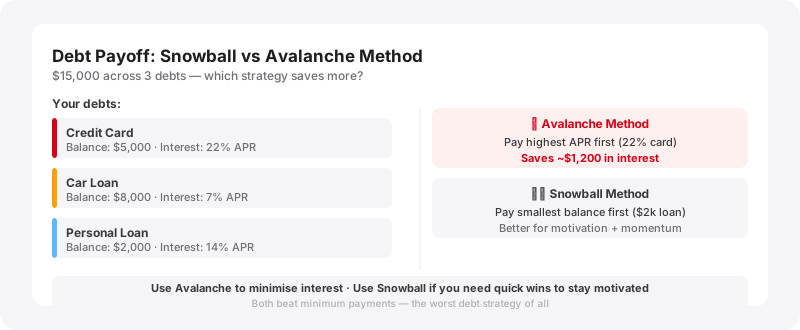
If you carry multiple debts — credit cards, personal loans, a car on finance, a student loan — the order in which you pay them off matters more than most people realise. The difference between strategies can add up to thousands of pounds or dollars in total interest. Two systematic methods dominate sensible debt repayment: the snowball and the avalanche. Both beat the default of paying minimums on everything and hoping for the best.
How to calculate your debt payoff timeline
- Add your debts. Enter each debt separately — balance, interest rate, and minimum payment. Add as many as you have.
- Choose your strategy. Avalanche (highest rate first) minimises total interest. Snowball (smallest balance first) gives faster psychological wins. The calculator shows both.
- Set your monthly budget. Enter how much total you can put towards debt each month — the sum of all minimums plus any extra you can afford.
- Read your payoff timeline. The result shows months to debt-free, total interest paid, and the order to pay off each debt under your chosen strategy.
Three debts: Credit card £3,000 at 22%, car loan £6,000 at 7%, personal loan £1,500 at 14%. Monthly budget: £400.
Paying down debt also improves your credit score, which lowers the interest rate you'll be offered on future borrowing.
- Pay minimums on car loan + personal loan
- Throw all extra at the credit card (highest rate)
- Once card is clear (~9 months), roll its payment into the personal loan
- Total interest saved vs minimums-only: ~£820
Prefer quick wins? Use snowball — tackle the £1,500 personal loan first for an early psychological boost.
Debt snowball: smallest balance first
Pay the minimum on every debt, then put every spare pound toward the smallest balance, regardless of interest rate. When that debt is cleared, roll its payment into the next smallest. Dave Ramsey popularised this approach, and the psychological argument for it is real: eliminating a debt entirely — even a small one — produces a concrete win. That win reinforces the habit. Research published in the Journal of Consumer Research found that people who focused on paying off individual accounts one at a time reduced their total debt faster in practice, because the motivation to continue was stronger.
Debt avalanche: highest rate first
Pay the minimum on every debt, then put every spare pound toward the highest-interest debt first. This is the mathematically optimal method. Eliminating the highest-rate debt reduces the total interest accruing across all your debts as fast as possible. On a set of three debts totalling £15,000, the avalanche can save £400–£1,200 in interest compared to the snowball, depending on rates and balances. The trade-off: if your highest-rate debt also has a large balance, you can go months without clearing a single account. Some people find this discouraging and abandon the plan entirely.
Hybrid approach: one quick win, then avalanche
A practical middle ground: identify one small debt you can clear within 2–3 months and pay it off first for the psychological boost. Then switch to the avalanche for the remainder. You sacrifice a small amount of mathematical efficiency for a motivational anchor — and the evidence suggests this often produces better real-world outcomes for people who have previously struggled to stick to a debt repayment plan.
What this calculator shows you
Enter each debt's balance, annual interest rate, and minimum payment. Add your available extra monthly payment — even £50–£100/month produces a measurable difference. The calculator simulates month-by-month repayment under your chosen method and produces: total months to debt-free, total interest paid, and the saving compared to minimums only. That saving figure is typically the most motivating number on the page.
The piece the calculator cannot model
It cannot account for new debt being added. The most common reason repayment plans fail is that spending continues to add to the balances being paid down. A repayment plan works best alongside a spending review — knowing your actual monthly take-home from our salary calculator is the starting point for finding the extra cash to accelerate repayment.
What the calculator tells you
Enter each debt's current balance, annual interest rate, and minimum payment. Add your available extra monthly payment — even £50–£100/month makes a substantial difference. The calculator simulates month-by-month repayment under your chosen method and tells you: the total months to become debt-free, the total interest paid, and the saving compared to paying minimums only. That last number is often the most motivating one.
One thing the calculator cannot do
It cannot account for new debt. The most common reason debt repayment plans fail is not the maths — it is spending that continues to add to the balances being paid down. If you are serious about becoming debt-free, the repayment plan needs to run alongside a spending review. Our salary calculator can help you see exactly how much is coming in each month, which is the starting point for finding the extra cash to accelerate repayment.
This debt payoff calculator lets you enter multiple debts — credit cards, personal loans, car finance — and calculates your debt-free date under the snowball method (smallest balance first) or avalanche method (highest interest rate first). Add a monthly extra payment to see how much time and interest you save versus paying minimums only.
Typical results: £15,000 of debt at average 18% APR paying £200/month extra clears approximately 3 years earlier than minimum payments and saves around £4,200 in interest. $8,000 credit card debt at 24.9% paying $300/month is paid off in 34 months saving $2,100 vs minimums-only.
How do I pay off £10,000 of debt faster?
To pay off £10,000 of debt faster, apply an extra payment above the minimums each month and direct it to either the highest-rate debt (avalanche) or the smallest balance (snowball). An extra £200/month on £10,000 of debt at 18% average APR cuts the payoff time from approximately 9 years (minimums only) to around 4 years and saves roughly £3,500 in interest.
What is the debt snowball method?
The debt snowball method means paying the minimum on all debts and directing all extra payments to the smallest balance first, regardless of interest rate. Once that debt is cleared, the freed payment rolls into the next smallest. The psychological benefit — eliminating debts completely, one by one — helps many people stay motivated and stick to the plan longer than the mathematically superior avalanche method.
Which is better: snowball or avalanche for debt repayment?
The avalanche method saves more money in total interest paid — always. But research shows that the snowball method produces better real-world outcomes for many people, because early wins create motivation that sustains the behaviour. If you are confident you will stick to a plan, choose avalanche. If you have struggled with consistency before, start with a snowball and switch once the habit is established.
Frequently Asked Questions
The debt avalanche method involves paying the minimum on all debts and directing any extra money toward the debt with the highest interest rate first. Once that debt is paid off, the freed-up payment rolls into the next highest-rate debt. This method minimises total interest paid.
The debt snowball method involves paying the minimum on all debts and directing extra money toward the smallest balance first, regardless of interest rate. The psychological satisfaction of eliminating debts quickly helps many people stay motivated and stick to the plan.
The avalanche method always saves more money in total interest paid, because you eliminate high-rate debt faster. However, research suggests that the snowball method leads to better outcomes for people who struggle with financial motivation, because of the psychological reward of early wins.
Generally, pay off any debt with an interest rate above 6-7% before investing (other than capturing employer pension matches, which are effectively an immediate 50-100% return). Debt at lower rates is less clear-cut and depends on expected investment returns, your tax situation, and risk tolerance.