Tip & Bill Splitter:
USA & Europe
Split any bill fairly, at any tip percentage, between any number of people — with tipping guidance for the USA and across Europe.
🔒 Every calculation runs in your browser — nothing sent to any serverCalculated using official rates — see our methodology. Tipping norms sourced from national hospitality industry guidelines.
→ Travelling abroad? Use our currency converter to tip in the right currency.
✓ Calculator reviewed May 2026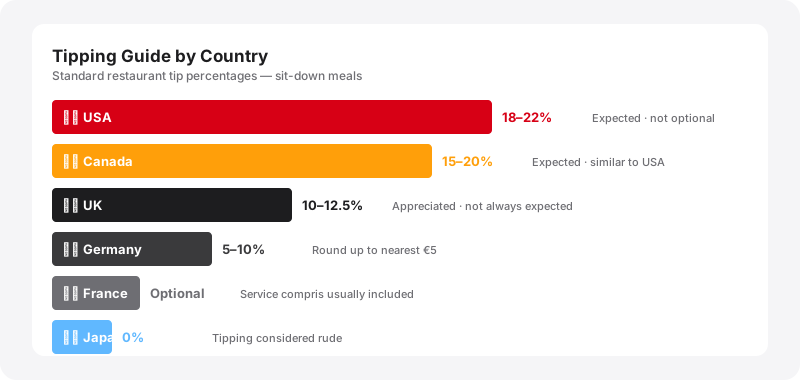
Tipping customs vary more than most people realise — not just between countries, but between types of restaurant, time of day, and even city within a country. In some places a tip is a deeply expected component of a server's income. In others it can cause confusion or mild offence. Getting this right is more about understanding context than following a universal formula.
How to split the bill and calculate the tip
- Enter the bill total. The total amount on the bill before tip — use the pre-tax subtotal in the US, or the full amount in the UK.
- Set the tip percentage. Use the quick-select buttons (10%, 15%, 18%, 20%, 25%) or enter a custom percentage.
- Enter the number of people. For bill splitting, enter how many people are sharing equally. Leave at 1 for no split.
- Read your results. You'll see the tip amount, total bill with tip, and the per-person share if splitting.
Bill: $87.50 for 4 people, USA, good service.
- Tip at 20%: $87.50 × 0.20 = $17.50
- Total with tip: $105.00
- Per person: $26.25
Quick mental maths: move the decimal (10% of $87.50 = $8.75), then double it for 20% tip = $17.50.
Tipping in the USA
In the United States, tipping restaurant staff is not optional in any practical sense — it is the primary mechanism by which servers are paid a living wage. US federal law permits employers to pay tipped workers as little as $2.13/hour, with the expectation that tips make up the difference to at least $7.25/hour minimum wage. In practice most servers in full-service restaurants earn $15–$25/hour including tips, but that income is entirely dependent on customer behaviour. The standard tip at a sit-down restaurant is 18–20%.
Fifteen percent is considered poor service. Twenty-five percent is considered genuinely generous. At a bar, $1–$2 per drink is standard. Counter service and fast food traditionally require no tip, though the rise of tablet payment screens asking for 18–22% at coffee shops and delis has blurred this.
Food delivery tips are typically 15–20% of the order value, with a minimum of $3–$5 for short distances regardless of percentage — the driver's time has a floor cost. Tipping on pre-tax total vs post-tax total makes a small but technically correct difference (tip on the pre-tax amount).
Tipping in the UK
The UK has no equivalent of the US tipped-worker minimum wage, so tipping is a supplement rather than a replacement for baseline pay. At a sit-down restaurant, 10% is considered standard for good service; 12.5% is generous; anything above that is uncommon unless the experience was exceptional. Many London restaurants add a 12.5% service charge automatically — check the bill carefully, because paying twice (once on the card and once in cash "for the staff") is an easy mistake. If a service charge is already on the bill, you are not expected to add more.
UK pub culture traditionally does not involve per-round tips. "Have one yourself" — offering to include a drink for the bartender — is the conventional acknowledgment of good bar service. For taxi drivers, rounding up to the nearest pound or adding 10% is normal. Hotel porters: £1–£2 per bag. Restaurant delivery: £2–£3 cash or via the app is appreciated.
Tipping in Europe
Continental European norms are closer to the UK than the USA. In France, Germany, the Netherlands, and Scandinavia, a service charge is typically included in menu prices and tips are genuinely optional. A small cash tip of 5–10% for good service is appreciated but never expected in the way it is in North America. In tourist areas of Spain and Italy, expectations have shifted toward more US-style tipping, particularly in establishments that market themselves to American visitors. In Japan, tipping is considered rude and should not be offered.
Using the bill splitter
Splitting a restaurant bill equally is simple arithmetic. The complication arises when people have ordered materially different amounts and feel awkward about the implied subsidy, or when the group includes people on very different incomes. The cleanest approach: each person pays for what they ordered, then the tip is split equally by head (since all diners benefited equally from the service). Our calculator handles both equal splits and per-item splits for exactly this situation.
This tip calculator computes the tip amount and per-person share for any restaurant bill. Select a tip percentage — 15%, 18%, 20%, or 25% for USA; 10% or 12.5% for UK — enter the bill total and number of diners, and the calculator shows the tip amount, total bill, and each person's share instantly.
Tipping quick reference: tip on a $85 restaurant bill at 20%? ($17 tip, $102 total, $25.50 each for 4 people). How much to tip on a £120 bill in the UK? (£12–£15 is standard 10–12.5%; check whether a service charge is already included first). 18% tip on $200? ($36 tip, $236 total).
How much should I tip at a US restaurant?
15% is considered a minimum for adequate service in US restaurants. 18% is now more common as a baseline. 20% is standard for good service. 25% is genuinely generous or for exceptional service. For counter service and coffee shops, tipping is optional — though digital payment screens increasingly prompt for 18–22%. For food delivery, 15–20% of the order total with a minimum of $3–$5 regardless of percentage.
Do you tip in the UK?
Tipping in the UK is appreciated but not obligatory in the way it is in the US. At a sit-down restaurant, 10% for good service is standard; 12.5% is generous. Many London restaurants automatically add a 12.5% service charge — check the bill before tipping additionally on a card. At pubs, tipping per round is not the norm; offering to include a drink for the bartender ("and one for yourself") is the traditional acknowledgment of good bar service.
Is 15% tip still acceptable in the USA in 2026?
15% tip is technically acceptable in the USA but is increasingly read as signalling borderline dissatisfaction. Post-pandemic, 18–20% has become the de facto standard at full-service restaurants. If service was genuinely poor, tip what you feel is fair — but the typical "decent service" baseline has shifted upward from where it was 10–15 years ago, particularly in major cities.
Frequently Asked Questions
In the USA, 18-22% is now considered standard for sit-down restaurants. 15% is acceptable for adequate service. Many servers rely on tips as the majority of their income, as tipped minimum wage can be as low as $2.13/hour in some states.
Tipping culture varies across Europe. In the UK, 10-12.5% is standard. In France, Italy and Spain, tipping is appreciated but not expected — rounding up or leaving a few euros is generous. In Germany and the Netherlands, rounding up to a convenient figure is common.
To split a bill evenly: add the tip to the total bill, then divide by the number of people. Our tip calculator does this automatically. Simply enter the bill amount, select your tip percentage, and enter the number of people.
In the US, it is conventional to tip on the pre-tax subtotal, though many people tip on the total. The difference is small — on a $100 meal with 10% tax, tipping 20% on the pre-tax amount is $20 vs $22 on the total.
Not tipping in the UK is rarely considered rude, unlike in the US. UK hospitality workers are paid at least the National Living Wage, so tips are genuinely optional. However, tipping 10–12.5% is appreciated for good service. Many restaurants add a discretionary service charge — you can ask for it to be removed.
In the UK, there is no legal requirement for restaurants to pass tips to workers, though the 2024 Employment (Allocation of Tips) Act now requires employers to pass on 100% of tips to staff fairly. In the US, tip pooling rules vary by state. When in doubt, tip in cash directly to the server.