How Much Will Your Mortgage Cost?
Calculate your exact monthly payment, total interest paid, and the full lifetime cost of any home loan — in seconds.
🔒 Every calculation runs in your browser — nothing sent to any serverCalculated using official rates — see our methodology. Rate data sourced from Bank of England published rates.
→ Comparing two deals? Use our mortgage comparison calculator to see exactly which saves you more.
→ Need a quick lookup? See our mortgage repayment tables for every common loan size from £150,000 to £500,000.
✓ Calculator reviewed May 2026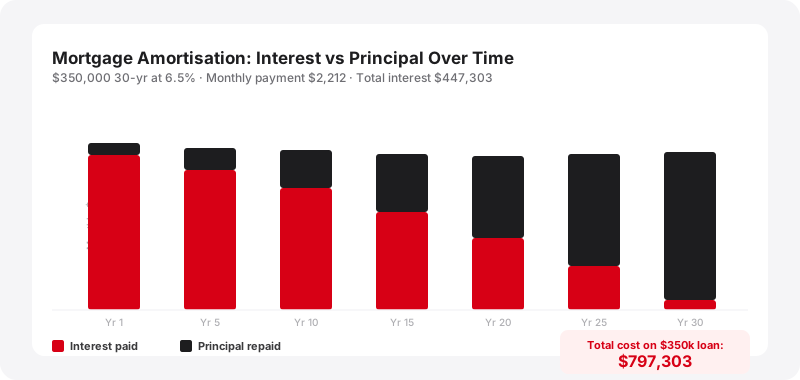
A mortgage is almost certainly the largest financial commitment you will ever sign. On a standard 30-year loan at current rates, the total amount you repay to the bank will typically be 1.6 to 2 times the original purchase price. Most buyers know their monthly payment. Far fewer know their total cost — and that gap is expensive.
How to calculate your mortgage payment
- Enter your home price. Type the total property value — not just the amount you're borrowing. The calculator will account for your deposit separately.
- Enter your deposit. Your down payment in the same currency. The difference between price and deposit is your loan amount.
- Set the mortgage term. Most UK mortgages run 25 years; US loans are typically 30 years. A shorter term means higher monthly payments but far less total interest.
- Enter your interest rate. Use the rate from your lender's offer, or the current average to compare. Try a range of rates to see the sensitivity.
- Read your results. You'll see the monthly payment, total interest paid over the full term, and the total cost. The gap between loan amount and total cost is the true cost of borrowing.
→ Already have a loan instead of a mortgage? Use our loan repayment calculator for personal loan and car finance calculations.
This calculator shows you both numbers: the monthly payment and the total interest over the life of the loan. The difference between them is the true cost of borrowing.
How mortgage payments are structured
Every monthly payment on a standard amortizing mortgage covers two things: interest on the outstanding balance and a portion of the principal. In the early years, the split is heavily weighted toward interest. On a $350,000 mortgage at 6.5% over 30 years, your first monthly payment is roughly $2,213. Of that, about $1,896 goes to interest and only $317 reduces the balance you owe. By year 25, the same payment splits roughly $400 interest and $1,813 principal. The loan does not cost less — the same interest rate applies throughout — but the balance shrinks faster as time goes on.
Suppose you borrow £300,000 at 5.0% APR over 30 years.
- Monthly payment: £1,753
- Total interest paid: £225,000
- Total repaid: £525,000 — 2.28× the loan amount
Paying an extra $200/month reduces total interest by ~$57,000 and cuts 6 years off the term.
This front-loading of interest is why extra early repayments are so valuable. Every extra dollar paid in the first few years reduces the balance that future interest accrues on. An extra $100/month from day one on a 30-year $350,000 loan at 6.5% saves approximately $40,000 in interest and cuts the loan term by nearly 5 years.
What drives your rate up or down
The interest rate quoted to you is not random. Lenders price loans based on risk, and several factors push your rate higher or lower. Loan-to-Value (LTV) is the most important: borrowing 60% of a property's value gets a materially better rate than borrowing 90%, because the lender's security position is stronger. A good credit history matters — missed payments, county court judgements (UK), or a recent bankruptcy will either raise your rate materially or disqualify you from certain lenders. Loan term also affects the rate, with shorter terms typically priced slightly lower. Property type can affect availability and pricing too: some lenders apply restrictions or higher rates for high-rise flats, new builds, or non-standard construction.
USA vs UK vs Europe: what changes
American buyers typically lock in a rate for the full 30-year term. This is unusual globally. UK mortgages fix for 2–5 years before reverting to the lender's Standard Variable Rate (SVR), which is almost always higher — meaning most homeowners need to remortgage every 2–5 years to stay on a competitive rate. In most of continental Europe, variable and tracker mortgages tied to the ECB's rates dominate, particularly in Spain, Portugal, and southern Europe. Fixed-rate culture is stronger in Germany and the Netherlands.
Fees and costs outside this calculator
This tool calculates principal and interest only. A real mortgage involves additional costs: in the UK, arrangement fees (£500–£1,500), valuation fees (£150–£1,500), solicitor's fees and Stamp Duty Land Tax. In the USA: origination fees (0.5–1.5% of loan), appraisal fees ($300–$600), title insurance, and if your down payment is below 20%, Private Mortgage Insurance (PMI) typically costing $50–$200/month until you reach 80% LTV. Factor all of these into your budget before committing, not after.
A good mortgage interest rate varies by country and economic conditions. In the USA, rates below the national average (typically 6-7% in 2024-2025) are considered competitive. In the UK and Europe, rates vary by lender and term length.
Most lenders in the USA and UK require a minimum deposit of 5-10%. However, putting down 20% or more eliminates Private Mortgage Insurance (PMI) in the USA, saving $100-$200 per month on most loans.
A 15-year mortgage has higher monthly payments but materially lower total interest paid over the life of the loan. A 30-year mortgage has lower monthly payments but costs much more in total interest over 30 years.
How much can I borrow on my salary?
Most UK lenders offer 4 to 4.5 times your annual income. On a £40,000 salary that means £160,000–£180,000. US lenders typically cap the mortgage payment at 28% of gross monthly income — on $70,000/year that is roughly $1,633/month including taxes and insurance, equating to a loan of around $230,000–$270,000 at current rates. Joint applications use combined income, which is why buying as a couple significantly increases your ceiling.
What is the monthly payment on a £200,000 mortgage?
On a £200,000 repayment mortgage at 4.5% over 25 years, the monthly payment is approximately £1,111. At 5.5%, it rises to £1,228. At 6.5%, it is £1,349. Total interest over the full 25-year term at 4.5% is roughly £133,000 — more than half the original loan amount. On a $200,000 US 30-year mortgage at 7%, monthly payments are approximately $1,331 with total interest around $279,000.
How much does 1% difference in mortgage rate cost?
On a £250,000 mortgage over 25 years, each 1% increase in rate adds approximately £30,000 to the total interest bill. On a 30-year $350,000 US mortgage, 1% more costs roughly $75,000 extra over the full term. This is why remortgaging at every fixed-deal renewal is worth the administrative effort — even a 0.5% saving on a £300,000 mortgage saves around £18,000 total.
Yes — most mortgages allow overpayments, typically up to 10% of the outstanding balance per year without an early repayment charge. Overpaying reduces the term and total interest significantly. Use our mortgage calculator to see how extra monthly payments shrink your total cost.
A fixed-rate mortgage locks your interest rate for a set term (2, 5, or 10 years in the UK; the full term in the US). A variable or tracker rate moves with the base rate. Fixed rates offer certainty; variable rates can be cheaper when base rates are falling.