Renting vs Buying a Home: Which Is the Better Financial Decision?
"Renting is throwing money away" is one of the most repeated and most misleading pieces of financial advice. Here is an honest, numbers-first comparison.
The decision to rent or buy is one of the largest financial choices most people face. "Renting is throwing money away" is one of the most repeated pieces of financial folklore — and one of the most misleading. The truth is far more nuanced, and for many people in many cities, renting is the smarter financial move.
This article is for informational and educational purposes only. It does not constitute personalised financial advice. Please consult a qualified independent financial adviser before making significant financial decisions.
The real cost of buying a home
Most buyers focus on the mortgage payment — but the total cost of homeownership is significantly higher. Before comparing renting to buying, you need to account for every cost of ownership:
- Mortgage interest — on a typical 30-year loan at 6.5%, you pay nearly 2× the purchase price in total
- Stamp Duty or property transfer tax — 2–12% of purchase price in the UK; 1–3% in many US states
- Solicitor / closing costs — typically £1,500–£3,000 (UK) or 2–5% of the purchase price (USA)
- Survey and inspection fees — £400–£1,500
- Maintenance and repairs — industry rule of thumb is 1–2% of the property value per year
- Buildings insurance — roughly £200–£500/year (UK)
- Service charges and ground rent — for leasehold properties, can be £1,000–£5,000/year
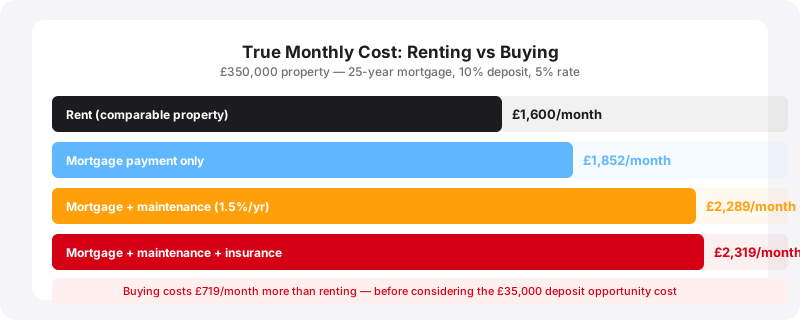
- Mortgage (25yr, 5% rate, 10% deposit): £1,852/month
- Stamp Duty (first-time buyer): £7,500 upfront
- Annual maintenance (1.5% of value): £5,250/year = £437/month
- Buildings insurance: £30/month
- Total effective monthly cost: ~£2,319
A comparable rental at £1,600/month looks expensive — but the buyer is paying £719 more every month before considering opportunity cost on the deposit.
The cost of renting — what people miss
Renting is not simply paying a landlord — it includes flexibility, zero maintenance responsibility, and the ability to keep capital invested elsewhere. The £35,000 deposit used to buy a house, if instead invested in a global index fund at 7% average annual return, becomes roughly £95,000 over 20 years.
That said, renters face real risks too: rent increases, landlord decisions to sell, and no accumulation of housing equity.
The break-even point
The critical question is: how long do you plan to stay? Buying has large upfront costs (stamp duty, legal fees, survey) that take years to recover through equity growth. The general breakeven is 5–7 years in most UK and US markets. If you're likely to move sooner, renting almost always wins financially.
When buying makes more sense
- You plan to stay in the property for 7+ years
- You're in a market where property values have historically grown faster than inflation
- Mortgage payments are similar to or lower than comparable rent in the area
- You value the stability, control, and ability to make structural changes
- You have a stable income and an emergency fund already in place
When renting makes more sense
- You may need to move for work or personal reasons within 5 years
- You're in a high price-to-rent ratio city (London, New York, Amsterdam) where buying is extremely expensive relative to renting
- House prices are elevated relative to historical norms — buying at the top of a cycle is risky
- You don't yet have a 10–20% deposit saved — buying with a small deposit means high LTV rates and expensive mortgage insurance
- Your income is variable or uncertain — homeownership requires reliable monthly payments
The price-to-rent ratio
A useful quick measure is the price-to-rent ratio: divide the property's purchase price by annual rent for a comparable property. A ratio below 15 generally favours buying; above 20 generally favours renting; 15–20 is a grey area depending on personal circumstances.
Example: A flat costs £300,000 to buy. Comparable rent is £1,400/month = £16,800/year. Price-to-rent ratio = 300,000 ÷ 16,800 = 17.8 — in the grey zone, leaning toward renting in most scenarios.
The honest answer
Buying beats renting over the very long term in most markets — but only if you stay long enough, only if you can afford the full cost of ownership without stretching dangerously, and only if you're comparing like with like. For many people in expensive cities who value flexibility, renting and investing the difference is a perfectly rational — and sometimes superior — financial strategy.
Questions worth asking before you decide
How stable is my income? A mortgage commits you to a fixed monthly payment for 25–30 years. If your income is variable, seasonal, or at risk, the flexibility of renting is genuinely valuable — not a cop-out.
How long will I actually stay? Be honest with yourself. The average UK homeowner moves every 9 years — but many people move sooner than expected due to career changes, relationship changes, or family circumstances. Every move resets your transaction cost clock.
Am I buying because I want to, or because I feel I should? Homeownership carries cultural weight in the UK and USA that doesn't always reflect financial reality. In many expensive cities, renting and investing the difference is a demonstrably better financial outcome. Use our mortgage calculator to model your actual monthly costs before deciding.
Have I factored in all the costs? Survey and legal fees, stamp duty, moving costs, initial furnishing, and the ongoing maintenance budget all need to be in your calculation. New buyers frequently underestimate these by 30–50%.
How renting vs buying compares across different markets
The rent vs buy decision looks very different depending on where you live. In the UK, the average house price-to-income ratio has risen from around four times earnings in 2000 to over eight times in 2024, making the deposit hurdle the primary obstacle for most first-time buyers. In London it is worse — closer to twelve times. In the US, the picture varies dramatically by state: in parts of the Midwest, buying is almost always financially superior within a few years; in San Francisco or New York, the maths rarely favours buying over a ten-year horizon unless you have significant equity.
Germany offers a useful counterpoint. Homeownership rates sit around 49% — one of the lowest in the developed world — yet Germans are not financially worse off than their counterparts in the UK or Ireland. The German rental market is simply better regulated, with longer tenancies, limited rent increases, and strong tenant protections. A mature, stable rental market changes the calculation entirely: when you can rent the same property for 25 years without fear of eviction, the flexibility argument for renting becomes much stronger.
Norway presents another variation: ownership rates are high (around 77%), aided by a culture of property investment, favourable mortgage markets, and limited rental protections by comparison. Australia has seen its rent vs buy decision tip sharply toward renting in Sydney and Melbourne over the past decade, as prices outpaced wages. The core lesson: there is no universal answer. The right choice is determined by local market conditions, not abstract principles.
The opportunity cost both ways
Most rent vs buy comparisons focus on the deposit — that lump sum you hand over when buying. But what is that money doing in the meantime if you rent instead? A £50,000 deposit invested in a global index fund returning an average 7% annually would be worth around £98,000 after ten years. That is the opportunity cost of buying: you lock up capital that could be compounding elsewhere.
On the other side, the opportunity cost of renting is the equity you are not building. Every mortgage payment contains a split between interest (which is a pure cost, like rent) and principal repayment (which builds equity you eventually get back). In the early years of a repayment mortgage, the split heavily favours interest — on a 25-year mortgage at 5%, roughly 70% of your first five years of payments goes to the bank in interest. This is not often discussed when people characterise rent as "throwing money away."
A cleaner comparison: calculate your total housing costs for both options over ten years. For renting, that is rent plus renters insurance plus the investment returns forgone on the deposit. For buying, that is mortgage interest, maintenance (budget 1–2% of property value annually), insurance, stamp duty or transaction taxes amortised over the holding period, and the theoretical investment return forgone on your deposit. Then compare net worth in both scenarios. In expensive cities, this exercise regularly shows renting is superior over periods under fifteen years.
What the research actually says
Several large studies have examined this question with real data. A 2021 analysis using US data found that renters who invested their would-be deposit and the monthly difference between rent and ownership costs came out ahead in 38 of 50 major cities over a fifteen-year period. A UK-focused study from the Resolution Foundation found that for buyers who purchased between 2000 and 2010, capital gains made buying look exceptional in hindsight — but that many of those gains were simply the result of falling interest rates pushing prices up, a tailwind unlikely to repeat.
The research consistently shows that the financial outcome depends heavily on three variables: how long you stay in the property, what happens to local property prices, and what alternative investments you would have made with the capital. The emotional and lifestyle factors — stability, personalisation, community roots — are genuinely valuable but cannot be quantified. They should go into your decision, but separate from the financial analysis, not tangled up in it.
Making the decision: a practical framework
If you are deciding right now, work through these questions in order. First: can you afford to buy without overextending? A mortgage should not exceed 4× your gross income, and your monthly payment should not exceed 35% of your take-home pay. If it does, wait or look in a different area. Second: how long will you stay? If less than five years, renting is almost certainly better once you account for transaction costs. Third: what is the price-to-rent ratio in your area? Divide the property price by the annual rent you would pay for a comparable property. Below 15, buying looks attractive. Above 20, renting and investing the difference becomes harder to beat. Fourth: are you buying in a rising or falling market? Nobody knows for certain, but consider the direction of local employment, population and interest rates.
Finally, give appropriate weight to the non-financial factors honestly. Stability matters. Being able to decorate, have pets, and put down roots matters. These are real benefits of ownership. Just do not let estate agents, family members, or cultural pressure make the decision for you on the basis of folklore. The numbers deserve to be run.
Sources & references
Five questions to ask before you decide
Rather than relying on a general rule, treat the rent vs buy decision as a structured analysis. First: what is your likely tenure? If you will move within five years, renting almost certainly wins once you factor in stamp duty, conveyancing costs, and estate agent fees on the way out. Second: what would you do with the deposit if you rented? If the answer is "spend it," buying may be better for enforced saving. If you would invest it disciplined, run the comparison properly. Third: are property prices in your target area above or below the long-run price-to-income ratio? Long-run UK average is around five times local earnings; significantly above that suggests prices are stretched. Fourth: how stable is your income and employment? Mortgage stress in a job loss scenario is categorically worse than rent arrears in the same scenario. Fifth: how much do you value permanence and control of your living space? This is a real and legitimate factor — just keep it separate from the financial analysis.
If the financial case is genuinely close — as it often is in mid-range UK cities and many US metro areas — the lifestyle question becomes the tiebreaker rather than an afterthought. Make the decision in that order, and you are unlikely to regret it either way.
Transaction costs: the invisible barrier to short-term ownership
One of the most consistently underestimated costs of buying is the exit cost. When you sell a property in the UK, you pay estate agent fees (typically 1–2% of sale price), solicitor fees (£1,500–£3,000), removal costs, and potentially mortgage early repayment charges. On a £300,000 property, these total £5,000–£9,000 before you have moved. Combined with the purchase costs (stamp duty, solicitor, survey), the round-trip cost of buying and selling is typically £15,000–£25,000. This means you need your property to appreciate by at least this much — purely to break even versus renting and investing the same money.
Frequently asked questions
No — this is one of the most repeated and least examined pieces of financial folk wisdom. Rent pays for housing, just as mortgage interest does. The key difference is that mortgage principal payments build equity. But in high-price markets, the opportunity cost of the deposit, plus transaction costs, means renting and investing the difference can outperform buying over holding periods under ten to fifteen years.
Divide the property purchase price by the annual rent you would pay for a comparable property. Below 15, buying is generally financially attractive. Between 15 and 20, it depends on your specific situation. Above 20, renting and investing the deposit becomes difficult to beat financially, especially over shorter time horizons. Many UK cities are well above 20.
As a rough rule, you need to stay at least five years to cover the round-trip transaction costs (stamp duty, legal fees, estate agent fees on sale) through capital appreciation and equity building. In very high-price markets with slow appreciation, the break-even period can extend to ten years or more. If you are likely to move within three to four years, renting is almost certainly more cost-effective.
Not necessarily, if you invest the difference between renting and owning costs consistently. The evidence is mixed — homeowners in the UK have historically benefited from substantial capital gains, but much of this was driven by falling interest rates (unlikely to repeat) and planning restrictions that artificially constrain supply. Disciplined renters who invest their deposit and cost savings can accumulate equivalent or greater wealth, but this requires genuine investment discipline rather than spending the savings.