Savings Calculator:
How Much Should You Save Each Month?
Enter your target, your timeline, and an expected return — and we will tell you exactly what to set aside each month to get there.
🔒 Every calculation runs in your browser — nothing sent to any serverCalculated using official rates — see our methodology. ISA limits and rules from HMRC gov.uk guidance.
→ Check whether inflation is eroding your savings rate with our inflation calculator.
✓ Calculator reviewed May 2026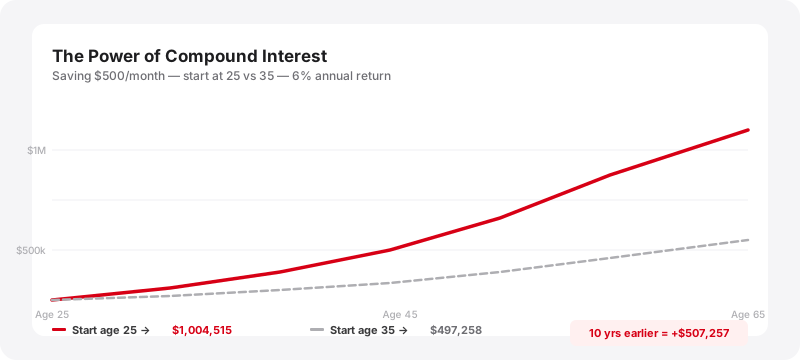
Saving money sounds simple. The mechanics are indeed simple. The difficulty is sustaining a habit that produces no immediate reward — unlike spending, which produces one immediately. Understanding the mathematics of what consistent saving actually produces over time is one of the most effective ways to make the long-term reward feel concrete enough to motivate the short-term sacrifice.
How to work out your monthly savings target
- Enter your savings goal. The total amount you want to accumulate — for example £10,000 for a house deposit or £500 for an emergency cushion.
- Set your monthly deposit. How much you plan to save each month. The calculator will show you how long it takes to reach your goal.
- Enter your interest rate. The annual rate your savings account pays. Check current best-buy rates — even small rate differences add up over years.
- Read your timeline. The result shows months to goal, total interest earned, and total contributions. Try increasing your monthly amount to see how it shortens the timeline.
Goal: Save £15,000 for a house deposit in 3 years. Savings account pays 4.5% AER.
- Monthly saving needed (simple): £15,000 ÷ 36 = £417/month
- With 4.5% interest compounded monthly (see our guide to compound interest): £387/month achieves the same goal
- Interest earned over 3 years: ~£1,044 — interest does £1k of the work
Using a Cash ISA keeps all interest tax-free in the UK. Higher-rate taxpayers should prioritise ISAs first.
This calculator answers the practical question: given a target, a timeline, and a realistic return, how much do you need to set aside each month? It uses the future value of annuity formula, adjusting for any money you have already saved.
The compound interest effect is real
People talk about compound interest as though it is a pleasant bonus. It is more like a law of nature: money earning returns on its accumulated returns grows exponentially, and the gap between "started early" and "started late" is much larger than most people intuitively expect.
A concrete example. Two people both want £100,000 by age 60. Alex starts at 30 and has 30 years; Sam starts at 40 and has 20 years. Both earn 5% annually. Alex needs to save approximately £121/month. Sam needs to save approximately £243/month — more than double — to reach the same target at the same age. Those ten years of headstart are worth £122/month in ongoing contributions.
The return rate matters, but less than most people think in the medium term. At 3% annual return over 10 years, the difference between 3% and 5% on a £200/month contribution is about £1,400. Over 30 years, that same gap grows to £50,000. Time amplifies rate differences.
The order of savings priorities
Before deciding how much to save toward a specific goal, the order you tackle financial objectives matters enormously for the maths:
First: an emergency fund. Three to six months of living expenses in an accessible account, not invested. This is your buffer against life — job loss, car repairs, medical costs. Without it, any unexpected expense derails your savings plan.
Second: employer pension matching. If your employer matches pension contributions, that match is an immediate, effective 50–100% return on your money before it even enters the market. Nothing in investing comes close to that. Maximise it before doing anything else.
Third: high-interest debt. Any debt above 6–7% annual interest is a certain effective return if you pay it off. Investing while carrying credit card debt at 20% is arithmetically irrational for most people.
Then: specific goals. This is where this calculator becomes useful — working out the exact monthly amount needed to hit a target by a deadline, whether that is a house deposit, a sabbatical, a car purchase, or a children's education fund.
Where to put your savings
The account type matters as much as the amount. In the UK, a Cash ISA protects interest from income tax; a Stocks and Shares ISA does the same for investment returns. In the USA, a 401(k) or IRA provides tax advantages that can be worth thousands over a savings lifetime. For goals under 3–5 years away, cash savings accounts are appropriate — the stock market is too volatile for short horizons. For goals beyond 5 years, a diversified investment portfolio typically produces better real returns than cash, particularly in a low-interest-rate environment.
A common guideline is the 50/30/20 rule: 50% of after-tax income for needs, 30% for wants, and 20% for savings and debt repayment. Start with whatever is realistic and increase by 1% every few months.
A competitive savings rate is typically at or above the current base rate set by your central bank. In the USA, look for high-yield savings accounts. In the UK, ISAs and easy-access accounts often offer competitive rates.
How much do I need to save per month to reach £10,000?
To save £10,000 from nothing in 2 years at 4.5% interest, you need approximately £390/month. Over 18 months: £527/month. Over 3 years: £263/month. If you already have £3,000 saved, the 2-year target drops to about £243/month. Compound interest makes a modest difference over short periods but becomes significant beyond 5 years — use the calculator above with your specific goal and timeline.
How does compound interest affect savings over time?
Compound interest means you earn interest on your accumulated interest, not just your original deposits. At 5% annual return, £10,000 grows to £16,289 after 10 years, £26,533 after 20 years, and £43,219 after 30 years — without any additional contributions. Add £300/month contributions at 5% return and after 30 years the balance reaches approximately £249,000. The compounding effect doubles and triples over multi-decade horizons.
How long does it take to save a house deposit?
A typical UK first-time buyer needs a 10% deposit. On a £250,000 property that is £25,000. Saving £400/month at 4.5% interest takes approximately 55 months — just over 4.5 years. On a £350,000 property (a 10% deposit of £35,000), the same monthly saving takes about 77 months — 6.5 years. Use the calculator above to model your specific target and see how extra contributions change the timeline.
For short-term goals (under 1 year), an instant-access savings account or Cash ISA gives you flexibility. For goals 2–5 years away, a fixed-rate bond or notice account often pays higher interest. Never lock money away you might need urgently — keep 3–6 months in instant access first.
Compound interest means you earn interest on your interest. If you have £1,000 earning 5% annually: year 1 earns £50, year 2 earns interest on £1,050 (= £52.50), and so on. Over 20 years at 5%, £1,000 becomes £2,653 — with £1,653 from compounding alone.
Yes — idle cash loses value to inflation even faster. The goal is to minimise the real loss by choosing accounts with the highest available interest rate. A savings account paying 4% when inflation is 3% still preserves more purchasing power than cash under a mattress at 0%.