Inflation Calculator:
What Is Your Money Really Worth?
Calculate the true purchasing power of any amount over any time period — and understand why cash savings quietly lose value every year.
🔒 Every calculation runs in your browser — nothing sent to any serverCalculated using official rates — see our methodology. Historical CPI data from Bank of England and ONS.
✓ Calculator reviewed May 2026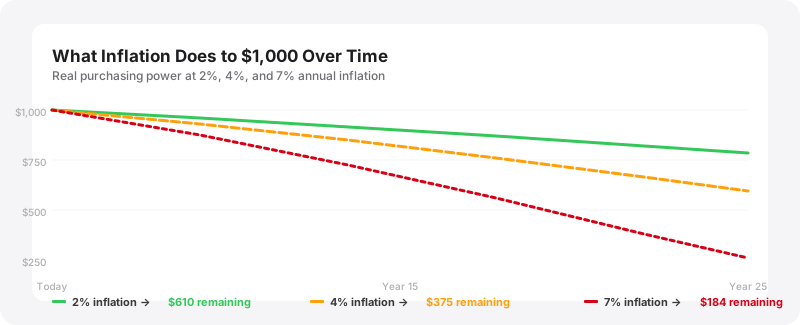
Inflation is not an abstract macroeconomic concept. It is a specific, measurable process by which money loses purchasing power over time — and its effects compound over decades just as surely as investment returns do, but in the opposite direction. A pound in 2000 bought what £1.86 buys in 2024. A pound in 1984 had the purchasing power of approximately £3.40 today. Year to year this erosion is quiet. Over the decades relevant to retirement planning and pension valuation, it is enormous.
How to calculate the effect of inflation
- Enter the original amount. The sum of money you want to adjust — for example £1,000 or $5,000.
- Set the start year. The year the original amount was worth that value. You can go back to 1950 or use recent years to model current savings erosion.
- Set the end year. Usually today, or a future year to project forward.
- Set the inflation rate. Use a historical average (UK CPI averages ~2.5% long-term, US ~3%) or enter current CPI for a real-time calculation.
- Read your results. The result shows the inflation-adjusted equivalent value and the total purchasing power lost or gained.
You have $50,000 in a savings account earning 2% interest. Inflation runs at 4%.
- After 10 years nominal value: $60,950
- After 10 years real value (inflation-adjusted): $41,120
- Real loss: $8,880 in purchasing power
Your money grew in number but shrank in value. To preserve purchasing power, your return must beat inflation after tax.
How inflation is measured
In the UK, two main indices are tracked. The Consumer Prices Index (CPI) measures the price of a representative basket of goods and services bought by UK households — food, clothing, transport, housing costs, leisure, and services. The Retail Prices Index (RPI) uses a similar basket but a different statistical formula and includes mortgage interest payments and council tax, which makes it tend to run higher than CPI. State benefit uprating, National Rail fare caps, and many index-linked investments use RPI. The Bank of England targets 2% CPI. In the USA, the Bureau of Labor Statistics publishes CPI-U monthly; the Federal Reserve targets 2% as measured by the PCE deflator.
Real returns vs nominal returns
A savings account paying 2% interest in a year when inflation runs at 3% produces a real return of approximately -1%. Your balance grew in nominal terms, but your purchasing power shrank. This negative real return has been the default condition for cash savings during most of the post-2008 period, when central bank rates were held near zero. It is why long-term wealth is built through investments — equities, property, businesses — that generate returns above the inflation rate over time. The nominal number on your savings statement is not the number that matters for long-term planning. The real return is.
The Rule of 70
A quick mental estimate for how long it takes purchasing power to halve: divide 70 by the annual inflation rate. At 2%, purchasing power halves in 35 years. At 3.5%, in 20 years. At 7%, in 10 years. During the 2022 inflation peak — when UK CPI hit 11.1% — purchasing power was on track to halve in under 7 years, which illustrates why the response from the Bank of England and Federal Reserve was so aggressive.
Using this calculator
This tool works in both directions. Moving forward from a past year shows what a historical amount is worth today — useful for comparing wages across decades, understanding real investment returns, or calculating inflation-adjusted salary growth. Moving backward shows what today's money was worth in a past year — useful for adjusting a pension target set years ago. Use it alongside the retirement calculator to factor purchasing-power erosion into long-term savings projections.
The Rule of 70
A quick mental calculation for estimating how long it takes purchasing power to halve: divide 70 by the annual inflation rate. At 2% inflation, purchasing power halves in 35 years. At 3.5%, in 20 years. At 7%, in 10 years. The post-pandemic 9% peak meant purchasing power was on track to halve in under 8 years — which is why central banks acted so aggressively to bring it back down.
Practical uses of this calculator
This calculator works in both directions. Going forward from a past year shows you what a historical amount would buy today — useful for comparing wages across eras, understanding the real cost of a past investment, or calculating inflation-adjusted salary changes. Going backward from today to a past year shows what current money was worth then — useful for understanding how a pension pot set in past money needs to be adjusted for today's costs. Use the retirement calculator alongside this one to factor inflation into long-term savings projections.
This inflation calculator converts any historical amount to its equivalent value today (or vice versa) at any annual inflation rate. Use it to understand the real purchasing power of past wages, historical savings, or pension values set years ago measured in today's money.
Quick reference answers: £1,000 in 1990 in today's money (at 3.5% average UK CPI: approximately £2,800 in 2026), $1,000 in 2000 is worth approximately $1,750 today at 3% US inflation, how much has the pound lost in value since 2010 (at 3% average: approximately 42% of purchasing power has been eroded — £100 in 2010 buys what £58 bought then).
What was £1,000 worth in 1990 in today's money?
Using a 3.5% average UK inflation rate (close to the long-run CPI average), £1,000 in 1990 is equivalent to approximately £2,800 in 2026. At the Bank of England's actual historical inflation data, the figure is close to £2,400–£2,600. This means purchasing power has roughly halved over the last 35 years — the same £1,000 buys less than half what it did in 1990.
How much has the cost of living increased since 2010?
Between 2010 and 2025, UK CPI inflation averaged approximately 2.8% per year, resulting in a cumulative price increase of around 52%. In other words, goods costing £100 in 2010 cost approximately £152 in 2025. The post-pandemic inflation spike in 2022–2023 (CPI peaked at 11.1% in October 2022) accounts for a large share of that cumulative change.
How does inflation affect my savings?
Inflation reduces the real value of cash savings. A savings account paying 2% interest in a year with 3% inflation produces a real return of approximately −1% — your balance grows in nominal terms but buys less. Over 20 years at 2% inflation, the purchasing power of £10,000 held in a 0% return account drops to the equivalent of about £6,730 in today's money. This is why financial advisors recommend investing rather than holding long-term savings entirely in cash.
Frequently Asked Questions
Using a 3.3% average US inflation rate, $1,000 in 1990 had the purchasing power of approximately $2,250 in 2026. In other words, you would need $2,250 today to buy what $1,000 bought in 1990.
Inflation erodes purchasing power. If your savings account pays 2% interest while inflation is 3%, your real return is -1% — your balance grows but buys less each year. Over 20 years, this effect compounds materially.
Inflation rates change frequently. In the USA, CPI inflation is tracked monthly by the Bureau of Labor Statistics. In the UK, the ONS publishes CPI data monthly. The Federal Reserve and Bank of England both target 2% annual inflation.
The Rule of 70 is a quick way to estimate how many years it takes for prices to double at a given inflation rate. Divide 70 by the annual inflation rate. At 3% inflation, prices double in roughly 23 years. At 7%, they double in 10 years.