Three Percentage
Calculators in One
What is X% of Y? X is what % of Y? What is the percentage change between two numbers? All three — handled instantly.
🔒 Every calculation runs in your browser — nothing sent to any serverCalculated using official rates — see our methodology. Standard percentage formulae; results verified against NIST reference.
→ Use our inflation calculator to calculate the real purchasing power change over time.
✓ Calculator reviewed May 2026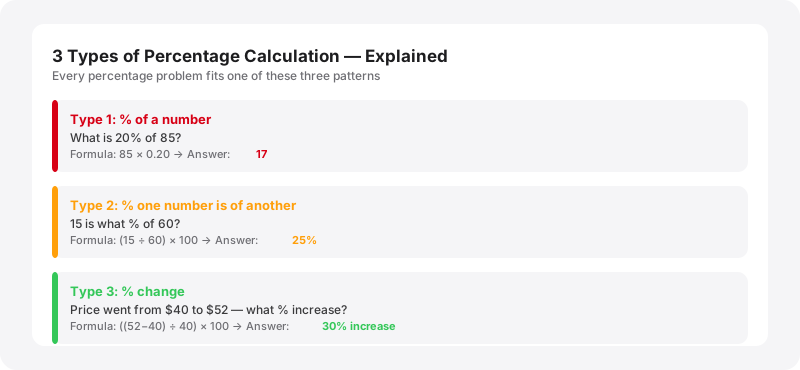
Percentages are everywhere — discounts, tax rates, exam scores, pay rises, interest rates, nutritional labels — and they trip people up far more often than they should. The confusion usually comes from conflating three different types of percentage question, each of which requires a different calculation. This tool handles all three, and the explanations below tell you when to use each one.
How to use the three percentage tools
- Choose your calculation type. Select one of three modes: "What is X% of Y", "X is what % of Y", or "% change from X to Y".
- Enter your numbers. Fill in the values shown for your chosen mode. Leave the result field blank — the calculator fills it in.
- Read your result. The answer appears instantly. The formula used is shown below the result so you can understand the calculation.
Type 1 — % of a number: What is 35% of £240?
£240 × 0.35 = £84
Type 2 — What % is X of Y: 45 is what % of 180?
(45 ÷ 180) × 100 = 25%
Type 3 — % change: Rent went from £900 to £1,080. What % increase?
((1,080 − 900) ÷ 900) × 100 = 180/900 × 100 = 20% increase
The three percentage calculations that matter
What is X% of Y? This is the most common use: what is 20% of £85? What is 7.25% sales tax on a $49 item? What is 15% of 240 calories? The formula is straightforward: (X ÷ 100) × Y. For 20% of £85, that is 0.20 × 85 = £17.
X is what % of Y? You have two numbers and need to express the relationship as a percentage. You scored 67 out of 80 on a test — what percentage is that? You spent £340 of a £1,200 budget — what percentage used? Formula: (X ÷ Y) × 100. So 67 ÷ 80 × 100 = 83.75%.
Percentage change from X to Y. A salary went from £32,000 to £35,500 — what percentage increase is that? A stock fell from $148 to $121 — what percentage drop? Formula: ((Y − X) ÷ X) × 100. So (35500 − 32000) ÷ 32000 × 100 = 10.9% increase.
Where people go wrong
The most common mistake is applying percentage changes in reverse. If a price rises 20%, then drops 20%, you do not end up where you started — you end up 4% lower. A £100 item rises to £120 (×1.20), then drops 20% to £96 (×0.80). This asymmetry catches people out in investment contexts especially.
Another common error: finding the pre-discount price from a discounted price. If something costs £68 after a 15% discount, the original price is not £68 + 15% of £68. It is £68 ÷ (1 − 0.15) = £68 ÷ 0.85 = £80. The discount was applied to the original price, not the discounted price.
Percentage points vs percentages
These are not the same thing and the distinction matters enormously in finance, politics, and medicine. If an interest rate rises from 3% to 4%, it has risen by 1 percentage point — but by 33% in relative terms. News coverage often blurs this. "Mortgage rates rose by 1.5 points" means something very different from "mortgage rates rose by 1.5 percent."
Practical percentage uses
Retail discounts and VAT calculations are the most searched use cases, but percentages come up constantly in everyday financial decisions: calculating whether a salary increase outpaces inflation, working out the real cost of a "0% finance" deal, comparing broadband or energy tariff changes, or checking whether a restaurant tip is correct. The calculation itself is simple once you know which of the three formulas applies.
This percentage calculator handles all three standard percentage problems in one place. What is X% of Y? — multiply Y by (X÷100). X is what % of Y? — divide X by Y and multiply by 100. Percentage change from X to Y? — subtract X from Y, divide by X, multiply by 100.
Common percentage questions answered instantly: what is 20% of 350? (70), what is 15% of 80? (12), 45 out of 60 is what percentage? (75%), percentage increase from 240 to 300? (25%), percentage decrease from £85 to £68? (20%). The calculator handles all of these and shows the working.
What is 20% of 150?
20% of 150 is 30. To calculate: divide the percentage by 100 to get a decimal (20 ÷ 100 = 0.20), then multiply by the number (0.20 × 150 = 30). Common quick examples: 10% of any number is that number divided by 10. 25% is divided by 4. 50% is divided by 2. 15% = 10% + half of 10%.
How do I calculate a percentage increase?
To calculate a percentage increase from one number to another: subtract the original from the new value, divide by the original, and multiply by 100. Example: from £240 to £300 is (300 − 240) ÷ 240 × 100 = 25% increase. From $80 to $68 is (68 − 80) ÷ 80 × 100 = −15% (a 15% decrease). The sign tells you whether it is an increase (positive) or decrease (negative).
How do I work out the original price before a discount?
If you know the discounted price and discount percentage, the original price is: discounted price ÷ (1 − discount/100). A £51 item after a 15% discount had an original price of £51 ÷ 0.85 = £60. Do not add 15% to £51 — that gives £58.65, which is wrong. The discount was applied to £60, not to £51, so the reversal must divide by (1 − rate) rather than add the rate.
Frequently Asked Questions
20% of 85 is 17. To calculate: divide the percentage by 100 to get a decimal (20 ÷ 100 = 0.20), then multiply by the number (0.20 × 85 = 17). This is the most common percentage calculation — used for discounts, tips, and tax.
To calculate a percentage increase: subtract the original value from the new value, divide by the original value, then multiply by 100. Example: from £32,000 to £35,500 is ((35500 − 32000) ÷ 32000) × 100 = 10.94% increase.
If you know the discounted price and the discount percentage, divide the discounted price by (1 minus the discount as a decimal). A £68 item after a 15% discount: £68 ÷ (1 − 0.15) = £68 ÷ 0.85 = £80 original price. Do not simply add 15% to £68 — that gives the wrong answer.
Percentage points measure the arithmetic difference between two percentages. If interest rates go from 3% to 5%, they rose by 2 percentage points — but by 67% in relative terms. This distinction matters in finance, economics, and medicine, where these terms are often confused in reporting.