BMI Calculator: What Your
Score Really Means
Calculate your Body Mass Index, see where you sit on the scale, understand your healthy weight range — and the important limitations of this widely used metric.
🔒 Every calculation runs in your browser — nothing sent to any serverCalculated using official rates — see our methodology. Classification thresholds from WHO adult BMI reference standards.
✓ Calculator reviewed May 2026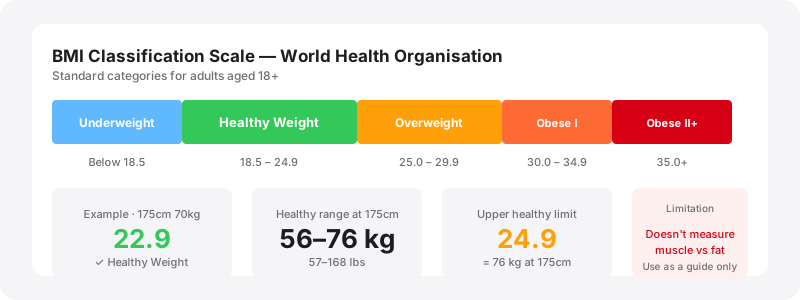
Body Mass Index has been around since the 1830s and remains the most used health screening number in the world. The formula is simple — weight in kilograms divided by height in metres squared — and produces a single number that doctors, insurers, and public health researchers use to categorise weight across populations. They use it because it is free to calculate, requires no specialist equipment, and correlates reasonably well with body fat levels across large groups of people.
How to calculate your BMI accurately
- Choose your units. Select metric (cm/kg) or imperial (ft/in, lbs) using the toggle at the top of the calculator.
- Enter your height. Stand straight without shoes. For metric, enter centimetres; for imperial, enter feet and inches separately.
- Enter your weight. Use a consistent measurement — morning weight before eating is most reliable for tracking over time.
- Read your BMI and category. Your result will show your BMI number and WHO category (underweight, healthy weight, overweight, or obese). Use the healthy weight range shown to understand how far you are from the healthy zone.
Height: 5 ft 10 in (178 cm). Weight: 185 lbs (84 kg).
BMI = weight(kg) ÷ height(m)² = 84 ÷ (1.78)² = 84 ÷ 3.168 = 26.5
- Category: Overweight (25.0–29.9)
- Healthy weight range at 178 cm: 59–74 kg (130–163 lbs)
- To reach BMI 24.9: lose 10 kg (22 lbs)
BMI doesn't distinguish muscle from fat — a muscular athlete can show "overweight" BMI while being very healthy.
The critical word there is populations. At the individual level, BMI has problems that are worth understanding before you read your result.
What the number actually tells you
A BMI of 18.5 to 24.9 is classified as healthy weight by the World Health Organisation and the US Centers for Disease Control and Prevention. Below 18.5 is underweight. Between 25 and 29.9 is overweight. At 30 or above, it is classified as obese. These cut-offs are used by GPs, hospitals, and insurance companies around the world.
On a population scale, these categories predict health risk reasonably well. At the individual scale, they can be wrong in both directions.
Where BMI breaks down
The most well-known failure case: a professional rugby player or competitive powerlifter may have a BMI of 28 or 29 with body fat in the low teens. BMI calls them overweight. That is wrong. The formula cannot tell the difference between a kilogram of muscle and a kilogram of fat — they weigh the same.
The less discussed problem is fat distribution. Two people can have identical BMIs but completely different fat locations. Visceral fat, stored deep in the abdominal cavity around the organs, drives cardiovascular risk, insulin resistance, and inflammatory markers far more than subcutaneous fat stored under the skin. BMI tells you nothing about which kind you have, or where it sits. Waist circumference — ideally kept below half your height in centimetres — is a better everyday proxy for this kind of risk.
Ethnicity matters too. Research has consistently shown that people of South Asian descent experience metabolic complications at lower BMI values than people of European descent. The World Health Organisation has issued guidance suggesting lower BMI cut-offs for Asian populations, though the standard calculator still uses the original thresholds.
Finally, sex and age. Women naturally carry more essential fat than men at the same BMI — fat required for hormonal and reproductive function. And body fat tends to increase with age in both sexes, even at stable weight, as muscle mass declines. A 60-year-old and a 25-year-old at the same BMI have different body compositions.
How to use your result
A BMI result within the healthy range with no other risk factors is reassuring. A result that is elevated is a reason to look more closely — not a diagnosis. The most useful next step is usually waist circumference measurement combined with a conversation with your GP or doctor, who can assess your full picture: blood pressure, cholesterol, blood glucose, family history, and lifestyle factors that a single number cannot capture.
Our body fat calculator uses the US Navy tape measure method to give you a more direct estimate of body composition if you want to go a step further. It is free, equipment-free, and more informative than BMI alone.
BMI is a useful population-level screening tool but has important limitations. It cannot distinguish muscle from fat, does not account for fat distribution, and may be less accurate for athletes, older adults, or people of certain ethnic backgrounds.
BMI is calculated by dividing your weight in kilograms by the square of your height in metres: BMI = kg/m². In imperial units: BMI = (lbs × 703) / inches².
The healthy weight range corresponds to a BMI of 18.5 to 24.9. For a person 175cm (5ft 9in) tall, this equates to approximately 57-76kg (125-167lbs).
What is a healthy BMI for women?
A healthy BMI for women is 18.5 to 24.9 — the same numerical range as for men. However, women naturally carry more essential body fat than men at the same BMI value. A BMI of 21–23 sits in the centre of the healthy range. For women over 60, some evidence suggests the ideal BMI may sit slightly higher at 24–27, since a lower BMI in older women is linked to increased fracture risk and reduced muscle mass.
What BMI is considered overweight or obese?
A BMI of 25.0 to 29.9 is classified as overweight by the WHO and NHS. A BMI of 30 or above is classified as obese — with further divisions at 35 (class II obese) and 40 (class III, formerly morbid obesity). These are population screening thresholds, not individual diagnoses. A highly muscular person can have a BMI above 25 with very low body fat; conversely, someone with a "healthy" BMI can carry dangerous levels of visceral fat.
How do I calculate BMI in stones and pounds?
To calculate BMI using stones and pounds: convert total weight to pounds (1 stone = 14 lbs), convert height to inches (1 foot = 12 inches), then use: BMI = (weight in lbs × 703) ÷ (height in inches)². Example: 11 stone (154 lbs) at 5 ft 6 in (66 inches) → BMI = (154 × 703) ÷ (66²) = 108,262 ÷ 4,356 = 24.9. Or use the calculator above — enter stones and pounds directly.
BMI uses the same formula for both sexes, but women naturally carry more body fat at the same BMI than men. A woman with a BMI of 22 may have a healthy body fat percentage while a man at 22 might be lightly muscular. Use body fat percentage for a more sex-specific measure.
The standard healthy range is 18.5–24.9 for adults, but research suggests slightly higher BMI (22–27) may be associated with better outcomes in adults over 65. Muscle mass naturally decreases with age, so BMI can underestimate body fat in older adults. Consult your GP for personalised guidance.
No — this calculator is designed for adults aged 18 and over. BMI in children is assessed differently using age- and sex-specific growth charts, and the categories are different from adult classifications.