Body Fat Calculator:
US Navy Method
Calculate your body fat percentage from body measurements — no scales needed. Includes fat and lean mass breakdown and a healthy range comparison.
🔒 Every calculation runs in your browser — nothing sent to any serverCalculated using official rates — see our methodology. Navy method formula validated by Hodgdon & Beckett (1984).
✓ Calculator reviewed May 2026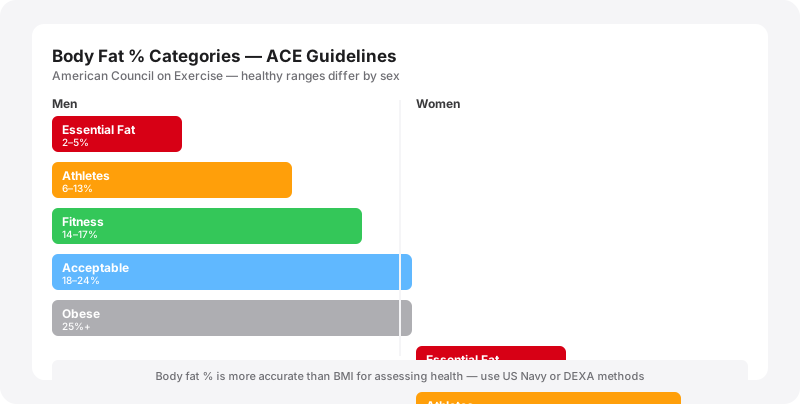
Body fat percentage is a more meaningful measure of physical composition than BMI, because it tells you what your body is actually made of rather than making inferences from height and weight. Two people with identical BMIs can have body fat percentages that differ by 10 percentage points or more — the difference between a fit, muscular build and a sedentary one at the same weight.
How to measure your body fat percentage
- Select your sex. The US Navy formula uses different measurements for men and women — men measure neck and waist; women measure neck, waist, and hips.
- Enter your height. Stand straight without shoes, measured in cm or inches.
- Take your measurements. Measure your neck at the narrowest point; waist at the navel (not the narrowest point); hips at the widest point (women only). Use a flexible tape measure and breathe normally.
- Read your body fat % and category. Your result shows estimated body fat percentage and the ACE category (essential, athlete, fitness, acceptable, obese). Compare against the healthy range for your sex.
Height: 178 cm (70 in) · Neck: 38 cm (15 in) · Waist: 86 cm (34 in)
Body fat % = 86.01 × log₁₀(waist − neck) − 70.041 × log₁₀(height) + 36.76
= 86.01 × log₁₀(34−15) − 70.041 × log₁₀(70) + 36.76 = ~17.2%
ACE "Fitness" category for men is 14–17%. This result sits right at the upper edge of fitness range.
What is a healthy body fat percentage?
Body fat norms differ substantially by sex because women carry essential fat in reproductive tissue that has no male equivalent. The ranges below are widely used by health professionals and fitness practitioners as guidelines:
Men: Essential fat sits at 2–5% — the absolute minimum required for physiological function. Athletes typically range from 6–13%. A fitness level (clearly defined musculature) corresponds to roughly 14–17%. The acceptable range for a healthy non-athletic adult is 18–24%. Above 25% is generally considered overweight; above 30% obese.
Women: Essential fat is 10–13%. Athletes: 14–20%. Fitness level: 21–24%. Acceptable healthy range: 25–31%. Above 32% is considered overweight; above 39% obese.
These are population averages and guidelines — they are not hard diagnostic thresholds. Age matters too: body fat naturally increases with age even in healthy, active people, particularly after 40. A 55-year-old at 24% body fat may be in excellent health, whereas a 25-year-old at the same level might have room to improve.
The US Navy Method — how it works
The US Navy formula estimates body fat from body circumferences rather than weight. For men, it uses neck and waist measurements. For women, it adds hip circumference. The formula was developed by the US Department of Defense for assessing military fitness standards and is reasonably accurate for most adults — typically within 3–4 percentage points of DEXA scan results.
The key is measurement technique. Waist circumference should be measured at the narrowest point (usually just above the navel for men, at the navel for women), with a relaxed abdomen. Not held in, not after a deep breath. Neck measurement is taken just below the larynx (Adam's apple). Hip measurement (women only) at the widest point of the hips and buttocks.
How body fat percentage affects health risk
The location of fat storage matters as much as the total percentage. Visceral fat — stored deep in the abdominal cavity around the organs — carries a much higher cardiovascular and metabolic risk than subcutaneous fat stored under the skin elsewhere. The waist measurement used in the Navy method is a reasonable proxy for visceral fat risk. A high waist-to-height ratio (waist cm ÷ height cm above 0.5) is associated with increased cardiometabolic risk regardless of total body fat percentage.
How to reduce body fat percentage effectively
Reducing body fat while preserving muscle mass is the goal for most people, not simply losing weight. The combination that works: a moderate calorie deficit (250–500 kcal below TDEE daily — see our calorie calculator), adequate protein intake (1.6–2.2g per kg of body weight daily), and resistance training to preserve or build lean mass. Cardiovascular exercise accelerates fat loss but is not required — the calorie deficit is the primary driver.
This body fat percentage calculator uses the US Navy circumference method — the same formula used by the US Department of Defense for military fitness assessments. It requires only a flexible measuring tape: height, neck, and waist for men; height, neck, waist, and hip for women. Accuracy is typically within 3–4 percentage points of DEXA scan results for most adults.
Common body fat questions: what body fat percentage is considered athletic for a man? (6–13%), healthy body fat percentage for a woman? (25–31% acceptable; 21–24% fitness level; 14–20% athletic), what is 15% body fat for a man? (fitness/visible muscle definition range — often a target for gym-goers). Enter your measurements above for your personal calculation.
What is a healthy body fat percentage for men?
For men, the acceptable healthy body fat range is 18–24%. Athletic level is 6–13% (clearly defined musculature). Fitness level is 14–17%. Essential fat — the minimum required for physiological function — is 2–5%. Above 25% is considered overweight; above 30% obese. Body fat increases naturally with age, so the same percentage means something different at 25 and 65.
What is a healthy body fat percentage for women?
For women, the acceptable healthy body fat range is 25–31%. Athletic level is 14–20%. Fitness level is 21–24%. Essential fat (required for hormonal and reproductive function) is 10–13% — considerably higher than men due to biological necessity. Above 32% is considered overweight; above 39% obese. These are population guidelines, not individual thresholds.
How accurate is the US Navy body fat formula?
The US Navy formula is accurate to within approximately 3–4 percentage points for most adults when measurements are taken correctly. It tends to underestimate body fat in very muscular individuals and overestimate in those with unusual fat distribution. DEXA scanning is the gold standard (accurate to 1–2%), but costs $50–$100 and requires a clinic visit. The Navy method is a free and reasonably accurate proxy for regular tracking.
Frequently Asked Questions
The US Navy method is accurate to within approximately 3–4 percentage points for most adults when measurements are taken correctly. It is less accurate for very muscular individuals (tends to underestimate fat) and very obese individuals. DEXA scanning remains the gold standard but the Navy method is a good free alternative for regular tracking.
For women, the acceptable healthy range is generally 25–31% body fat. Athletes typically range from 14–20%. Essential fat (the minimum required for basic physiological function) is 10–13%. Age naturally increases body fat percentage, so slightly higher numbers are normal and healthy for older women.
For men, the acceptable healthy range is generally 18–24% body fat. Athletes range from 6–13%. Essential fat is 2–5%. As with women, body fat increases naturally with age and higher percentages are normal in older men. The location of fat — abdominal vs elsewhere — matters as much as the total percentage.
For the US Navy method, measure at the narrowest point of the waist — typically just above the navel. Do not suck in or hold your breath. Use a flexible measuring tape pulled snug but not compressing the skin. Take the measurement after a normal exhale for consistent results.
Uses the US Navy method. Measure with a flexible tape, not stretched tight. Breathe normally.