Pension vs ISA: Which Should You Choose?
Both pensions and ISAs offer tax advantages, but they work very differently. This guide compares them on tax, flexibility, and access — and gives a clear priority order.
If you have money to save and you live in the UK, you face a genuinely tricky choice: should it go into a pension or a Stocks and Shares ISA? Both offer tax advantages, but they work very differently and suit different situations. This guide walks through the key differences and helps you decide which is right for you.
This article is for informational and educational purposes only. It does not constitute personalised financial advice. Please consult a qualified independent financial adviser before making significant financial decisions.
The key difference in one sentence
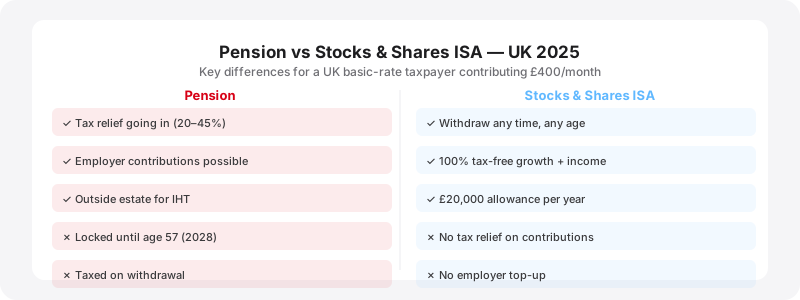
A pension gives you tax relief going in but is taxed when you take the money out. An ISA gives you no tax relief going in but is completely tax-free when you withdraw — at any age.
How pension tax relief works
When you contribute to a pension, the government adds basic-rate tax relief (20%) on top. So a £80 contribution becomes £100 in your pension. Higher-rate taxpayers can claim an additional 20% via their self-assessment tax return, making a £100 pension contribution cost them just £60 out of pocket.
Most workplace pensions also include employer contributions — typically 3–5% of salary on top of what you put in. This is essentially free money and is almost always worth maximising before considering any other savings vehicle.
You earn £50,000 and contribute £400/month to your pension.
- Basic-rate relief (20%): £400 net contribution = £500 in your pension
- If you're a higher-rate taxpayer: you can reclaim a further £100 via tax return — your effective cost is £300/month for £500 in the pension
- Employer adds 5% of salary: +£208/month extra
- Total going into pension: £708/month for your £400 outlay
How ISAs work
The ISA allowance is currently £20,000 per tax year. You contribute from after-tax income — no relief going in — but all growth and withdrawals are completely free of income tax and capital gains tax, for life. You can withdraw at any time with no penalty and no tax consequences.
Stocks and Shares ISAs invest in funds, shares, or bonds. Over 20+ years, this can generate substantial tax-free returns that would otherwise be subject to capital gains tax (currently 18–24% in the UK for investment gains).
Pension vs ISA: the pros and cons
- Pension wins on tax efficiency if you're a higher-rate taxpayer — the upfront 40% relief is hard to beat
- ISA wins on flexibility — you can access the money at any age, no minimum retirement age
- Pension wins for employer contributions — your employer can only match pension contributions, not ISA contributions
- ISA wins for access — buying a house, career break, or early retirement before 57 (the minimum pension access age from 2028)
- Pension wins for inheritance tax — pensions typically sit outside your estate for IHT purposes (though this is under review as of 2026)
The recommended order of priority
Most financial planners suggest this sequence:
- Employer matched pension first — maximise the match before anything else. It's free money.
- Build your emergency fund — 3–6 months of expenses in cash before locking anything away long-term.
- High-interest debt — pay off anything above 6% APR before saving aggressively.
- Further pension contributions — especially if you're a higher or additional-rate taxpayer.
- ISA — for medium-term goals (buying a home, early retirement, sabbatical) or once you've maximised pension contributions.
The Lifetime ISA — a special case
If you're aged 18–39 and saving for a first home or retirement, the Lifetime ISA (LISA) offers a 25% government bonus on contributions up to £4,000/year — a bonus of up to £1,000/year. This is equivalent to basic-rate pension tax relief, making it worth considering alongside or instead of a pension for eligible savers.
However, the LISA has a significant penalty: withdrawals for any purpose other than a first home purchase or retirement (age 60+) incur a 25% withdrawal charge, which effectively eats into your own contributions. Use it only if you're confident about the purpose.
The bottom line
For most people in the UK: max your employer pension match first, keep 3–6 months in an emergency savings account, then split remaining savings between further pension contributions (for the tax relief) and an ISA (for the flexibility). The right split depends on when you expect to need the money and your tax rate.
Common questions about pensions and ISAs
Can I have both a pension and an ISA? Yes — and for most people, you should. They are not mutually exclusive and serve different purposes. A pension maximises tax efficiency for money you won't need until retirement. An ISA provides flexible access to money you might need sooner.
What if I need my pension money before 57? Currently the minimum pension access age is 55, rising to 57 in 2028. Accessing a pension early is possible in very limited circumstances (serious illness) but generally not available. An ISA has no access restrictions — this is its key advantage for anyone planning to retire before 57 or needing funds for other medium-term goals.
Is it worth contributing once I've hit the annual pension allowance? The annual pension allowance is £60,000 (or 100% of earnings, whichever is lower). Very few people reach this limit. Once you do, an ISA becomes the next best vehicle. Beyond that, a general investment account is the next option, subject to capital gains tax on disposal.
How do I know how much I'll have at retirement? Use our retirement planner to model your projected pot size at different contribution rates and growth assumptions. Even rough projections are far better than none — the most common retirement regret is not saving enough, early enough.
The annual allowance and carry forward
Pension contributions are generous in terms of tax relief but capped by the annual allowance — the maximum you can contribute to pensions in a tax year while still receiving relief. In 2025/26, the standard annual allowance is £60,000, or 100% of your earnings if lower. This covers both your own contributions and any employer contributions. Above this limit, you pay a tax charge equal to your marginal rate on the excess.
Carry forward allows you to use unused annual allowance from the previous three tax years, provided you were a member of a registered pension scheme in those years. This is particularly useful for self-employed people with variable income, or employees who receive large bonuses and want to shelter them efficiently. To use carry forward, you must first exhaust the current year's full annual allowance, then work backwards through the three preceding years.
The Money Purchase Annual Allowance (MPAA) is a reduced allowance of £10,000 that applies once you have flexibly accessed a defined contribution pension — for example, taken an income from a drawdown fund. If you plan to continue working and contributing while drawing pension income, the MPAA is a critical consideration.
The tapered annual allowance for high earners
For those earning over £260,000 (adjusted income) in 2025/26, the annual allowance is tapered down — reduced by £1 for every £2 of income above the threshold, to a minimum of £10,000. This catches a relatively small number of people but the effect can be significant: a doctor, partner at a professional services firm, or senior executive earning £360,000 has an annual allowance of just £10,000, not £60,000.
The interaction between the tapered allowance and defined benefit pension accrual (where pension input is measured as 16× the annual pension increase) has created significant complexity for NHS consultants and similar public sector workers, many of whom have inadvertently triggered annual allowance charges worth tens of thousands of pounds. If you are affected, specialist pension tax advice is not optional.
Stocks and Shares ISA vs pension for long-term investing
For long-term wealth accumulation, both Stocks and Shares ISAs and pension wrappers are tax-efficient, but they work differently. Money in an ISA grows free of income tax and capital gains tax, and withdrawals are entirely tax-free at any age. Money in a pension grows with income tax relief on contributions (essentially a 20–45% top-up depending on your tax rate), grows free of tax, but withdrawals in retirement are taxed as income (except the 25% tax-free lump sum).
For a basic rate taxpayer with no expectation of higher rate liability in retirement, the pension is generally superior for money you will not need before age 57 — the government top-up on contributions is the decisive advantage. For a higher rate taxpayer who expects to be a basic rate taxpayer in retirement, the pension provides 40% relief on the way in and only 20% tax on the way out — an arbitrage that is hard to beat. The ISA wins for money you might need before retirement, or if you have used the pension annual allowance and have savings left over.
The interaction with Child Benefit and state benefits
Pension contributions reduce your adjusted net income for tax purposes, which affects several means-tested calculations. The High Income Child Benefit Charge applies where the higher earner in a family has income over £60,000, clawing back Child Benefit at 1% per £200 above the threshold. Pension contributions bring your adjusted net income down, potentially below the £60,000 threshold and saving the full Child Benefit charge. For a family with three children, this could be worth £3,000–£4,000 per year.
Similarly, the personal savings allowance, marriage allowance, and certain tax credit calculations are all linked to adjusted net income. A pension contribution that moves you from £51,000 to £49,000 might simultaneously avoid the 40% tax bracket, preserve your personal savings allowance, and maintain eligibility for certain allowances. These compound benefits are frequently missed and represent some of the most overlooked tax planning available to middle-income earners.
Sources & references
Self-employed pension planning: the options
Self-employed workers in the UK do not have access to employer contributions, which removes one of the most compelling arguments for pension-first saving. However, the tax relief on pension contributions applies in the same way. A self-employed person making £60,000 profit can contribute up to £60,000 to a SIPP, receiving 20% basic rate relief automatically, with higher rate relief claimed through self-assessment. This makes the SIPP a powerful tool for reducing income tax bills in high-earning years.
The Nest pension scheme (originally designed for auto-enrolled employees) is available to the self-employed. More flexible options include Vanguard Personal Pension, Royal London, and standard SIPP products from interactive investor, Hargreaves Lansdown, and AJ Bell. Low-cost index-tracking investment options within SIPPs have significantly improved for self-employed savers in recent years, removing one of the historical arguments for preferring a Stocks and Shares ISA.
For the self-employed, the sequencing question shifts somewhat: because income is unpredictable, maintaining a larger cash buffer before committing heavily to pension contributions is rational. Pension contributions are, by design, illiquid until age 57 (rising to 58). An emergency fund of eight to twelve months should precede aggressive pension saving for most self-employed individuals, whereas employees with stable income can afford to prioritise the pension earlier.
The verdict: which wins?
For most employed people in the UK, the correct answer is: maximise employer pension matching first (this is free money and cannot be replicated), then contribute to a pension up to the higher rate threshold, then use a Stocks and Shares ISA for additional savings. The ISA provides flexibility the pension cannot — accessible at any age without tax charges, useful for financial goals before retirement, and a simpler inheritance planning tool.
For those who are basic rate taxpayers now and expect to remain so in retirement, the pension and ISA are broadly equivalent in tax terms once you account for the 25% tax-free lump sum from the pension. The pension wins if your employer contributes; the ISA wins if you might need the money before 57, or if you are concerned about future changes to pension policy. Holding both is rarely wrong.
Passing wealth on: ISA vs pension inheritance
ISAs and pensions have very different inheritance tax treatment. ISAs are included in your estate and may be subject to 40% inheritance tax on amounts above the nil-rate band (currently £325,000, or £500,000 including the residence nil-rate band). However, ISA assets can be passed to a spouse or civil partner without IHT. Pensions sit outside your estate entirely for inheritance tax purposes — one of their most significant but least understood advantages. A pension fund passed to a beneficiary bypasses IHT entirely. Additionally, if you die before age 75, pension funds can be passed to beneficiaries income-tax free; after 75, they pay income tax at their own marginal rate on withdrawals.
This creates a clear implication for estate planning: spending down your ISA before your pension in retirement is often tax-efficient, leaving the pension for inheritance. The larger the estate and the more IHT-exposed, the more compelling this argument becomes. The pension then functions as an IHT wrapper as much as a retirement income vehicle — a role that is poorly communicated by most financial marketing.
Frequently asked questions
Yes — and for most people with spare savings after pension contributions, you should. The annual ISA allowance (£20,000) and the pension annual allowance (£60,000) are completely separate. Using both gives you the upfront tax relief of the pension plus the tax-free flexible access of the ISA.
ISAs form part of your estate for inheritance tax purposes, though they can be passed to a spouse or civil partner tax-free using the Additional Permitted Subscription rules. Your pension, by contrast, sits outside your estate and can be passed to beneficiaries free of inheritance tax — making pensions a powerful IHT planning tool for those with larger estates.
The standard annual allowance is £60,000, or 100% of your earnings if lower. This includes both your own contributions and any employer contributions. Higher earners above £260,000 adjusted income face a tapered reduction, down to a minimum of £10,000. Unused allowance from the previous three years can be carried forward.
Always take the full employer match first — it is an immediate 100% return on your contribution that no ISA can match. Beyond the matched amount, the choice between pension and ISA depends on your tax rate now versus retirement, whether you might need the money before age 57, and your overall estate planning position.