Period & Ovulation
Calculator
Estimate your next period, ovulation date, and fertile window — based on your cycle length and the start of your last period.
🔒 Every calculation runs in your browser — nothing sent to any serverCalculated using official rates — see our methodology. Cycle prediction based on Ogino-Knaus calendar method.
→ Track overall health alongside your cycle with our BMI calculator and TDEE calculator.
✓ Calculator reviewed May 2026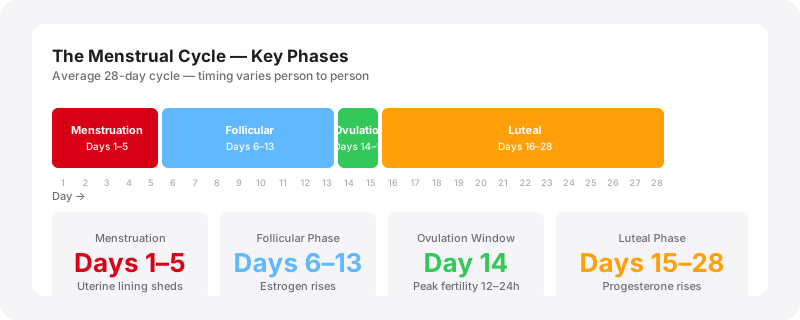
Tracking your menstrual cycle is one of the most practical things a person with a uterus can do for their health. Beyond predicting periods, cycle tracking reveals patterns that can indicate hormonal shifts, stress responses, thyroid changes, and other health signals well before they become symptoms that warrant a doctor's visit. It is not just a fertility tool — it is a health monitoring practice.
How to track your cycle and predict your period
- Enter the first day of your last period. Use the date picker to select the date your most recent period started — not when it ended.
- Enter your average cycle length. Most cycles are 21–35 days. If you're unsure, 28 days is the default. Tracking 3–6 previous cycles gives a more accurate average.
- Enter your average period length. How many days your period typically lasts — usually 3–7 days.
- Read your predictions. The calculator shows your next expected period date, estimated ovulation date, and fertile window. Predictions are estimates — cycle length varies naturally.
Last period started: 1 March. Cycle length: 28 days.
- Next period expected: 29 March
- Ovulation (Day 14): ~15 March
- Fertile window: 10–16 March (5 days before + day of ovulation)
For a 32-day cycle, ovulation shifts to ~Day 18 (~19 March). Cycle length, not calendar month, determines the fertile window.
Understanding the menstrual cycle
A "normal" menstrual cycle ranges from 21 to 35 days, with the average sitting around 28 days. The first day of your period is Day 1. The cycle has four phases: menstruation (Days 1–5 on average), the follicular phase (Days 1–13), ovulation (around Day 14 in a 28-day cycle), and the luteal phase (Days 15–28). These phases are averages. Your cycle may be consistently shorter, longer, or variable — all of which can be normal for you specifically.
The luteal phase — from ovulation to the start of the next period — is the most consistent part of the cycle for most people. It typically lasts 12–16 days regardless of cycle length. This means that if you have a 32-day cycle, ovulation likely occurs around Day 16–20, not Day 14. Using a fixed "Day 14 = ovulation" assumption for longer cycles is a common source of miscalculation.
The fertile window
Sperm can survive in the reproductive tract for up to 5 days. An egg is viable for 12–24 hours after ovulation. This means the fertile window extends from roughly 5 days before ovulation to 1 day after — a window of approximately 6 days per cycle. The two days immediately before ovulation and the day of ovulation itself carry the highest probability of conception.
Our calculator estimates this window based on your cycle length and last period start date. It uses the average luteal phase assumption of 14 days to back-calculate ovulation from expected next period date. For cycles that vary by more than 3–4 days month to month, tracking basal body temperature (BBT) or using LH surge tests gives more reliable individual ovulation timing.
What affects cycle regularity?
Cycles are sensitive to many external factors. Stress is one of the most common disruptors — cortisol can delay or suppress ovulation, extending the follicular phase. Significant weight changes (either direction), intense exercise, illness, travel across time zones, and starting or stopping hormonal contraception all commonly cause cycle irregularity. A single irregular cycle is rarely a cause for concern. Persistent irregularity — cycles consistently outside the 21–35 day range, or periods that stop for 3 or more months without pregnancy — warrants a conversation with a healthcare provider.
A note on using this tool for contraception
This calculator is an educational planning tool. Calendar-based period and ovulation prediction has a failure rate of approximately 24% per year when used as the sole method of contraception — meaning roughly 1 in 4 people relying on it as their only contraceptive method will experience an unintended pregnancy within a year. It should not be used as a contraceptive method on its own. Consult a healthcare provider for reliable contraceptive options appropriate for your circumstances.
This period and ovulation calculator estimates your next period date, ovulation day, and fertile window based on the first day of your last period and your average cycle length. The fertile window calculation uses the standard assumption that ovulation occurs approximately 14 days before the next period — meaning for a 32-day cycle, ovulation falls around day 18, not day 14.
Common cycle questions: when will my next period start if my last period was 10 February with a 28-day cycle? (approximately 10 March), when do I ovulate with a 30-day cycle? (around day 16, approximately 14 days before the next period), what is the fertile window? (5 days before ovulation plus the day of ovulation itself — 6 days total). Enter your dates above for personalised estimates.
When will my next period start?
Your next period is estimated by adding your average cycle length to the first day of your last period. If your last period started 10 February and your cycle is 28 days, the next is expected around 10 March. If your cycle is 32 days, the next period is expected around 13 March. Cycles vary by 2–4 days month to month for most people, so this is an estimate within that margin.
When do I ovulate based on my cycle length?
Ovulation typically occurs approximately 14 days before the start of your next period — not 14 days after your last period. For a 28-day cycle: around day 14. For a 32-day cycle: around day 18. For a 24-day cycle: around day 10. The luteal phase (ovulation to next period) is typically 12–16 days and is more consistent across individuals than the follicular phase.
What is the fertile window in the menstrual cycle?
The fertile window spans approximately 6 days: the 5 days before ovulation and the day of ovulation itself. Sperm can survive in the reproductive tract for up to 5 days, and an egg is viable for 12–24 hours after ovulation. The 2 days immediately before ovulation and the day of ovulation carry the highest probability of conception. For a 28-day cycle, the fertile window is approximately days 10–15.
Frequently Asked Questions
Add your average cycle length to the first day of your last period. If your last period started on 1st March and your cycle is 28 days, your next period is expected around 29th March. Cycles vary month to month, so this is an estimate with a typical margin of ±2–4 days.
Ovulation typically occurs about 14 days before the start of your next period — not 14 days after your last period, unless your cycle is exactly 28 days. For a 32-day cycle, ovulation is closer to Day 18. For a 24-day cycle, it is closer to Day 10.
The fertile window is typically 6 days: the 5 days before ovulation and the day of ovulation itself. The 2 days immediately before ovulation and ovulation day carry the highest probability of conception. Sperm can survive in the reproductive tract for up to 5 days.
A normal menstrual cycle ranges from 21 to 35 days, with the average around 28 days. Anything within this range that is consistent for you is generally considered normal. Cycles shorter than 21 days or longer than 35 days, or cycles that vary by more than 7–9 days from month to month, are worth discussing with a doctor.
Estimates are based on average cycle patterns. Individual variation is normal and common. Do not use for contraception. Consult a healthcare provider for medical guidance.